IGS Audio
IGS Audio RB 500
Choose options
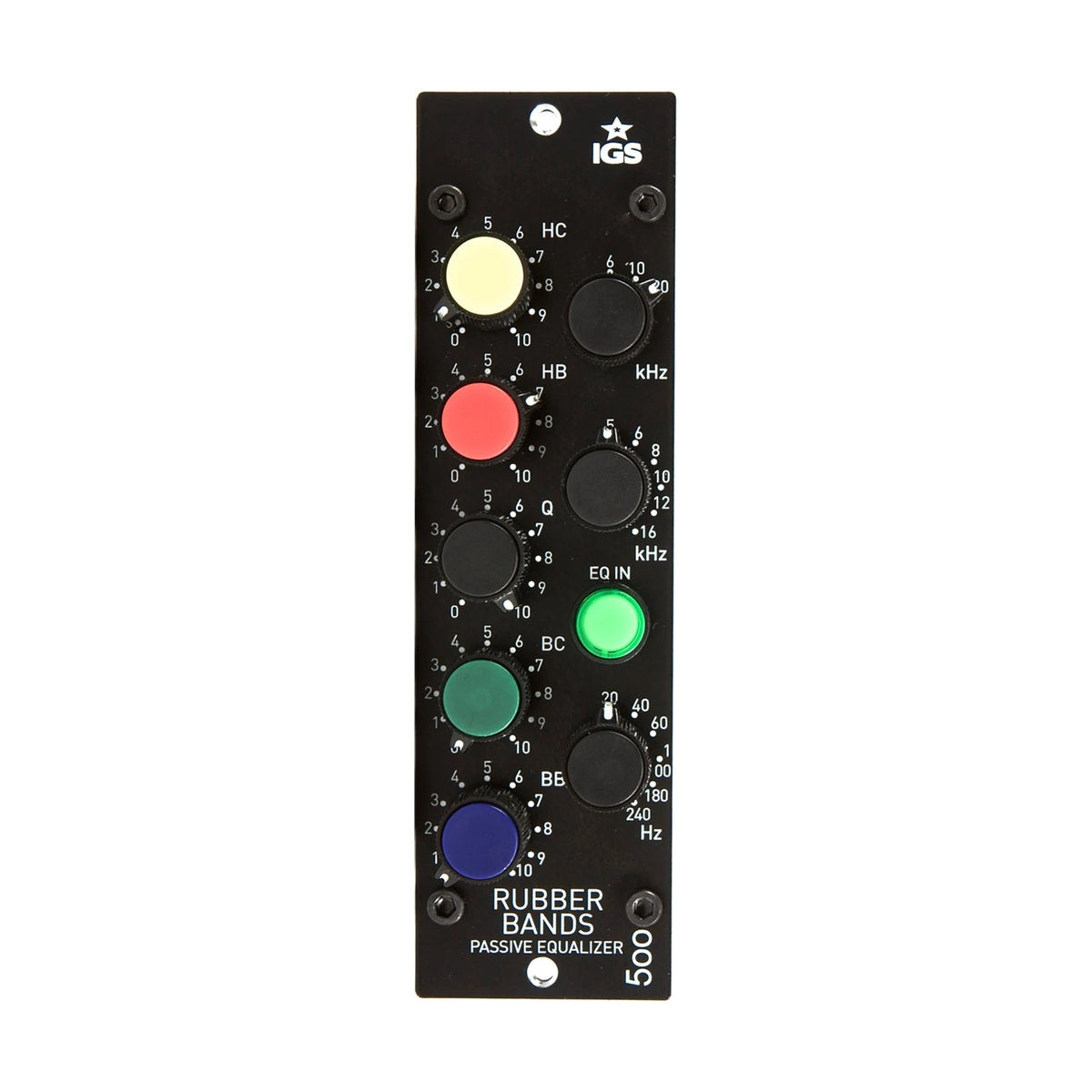
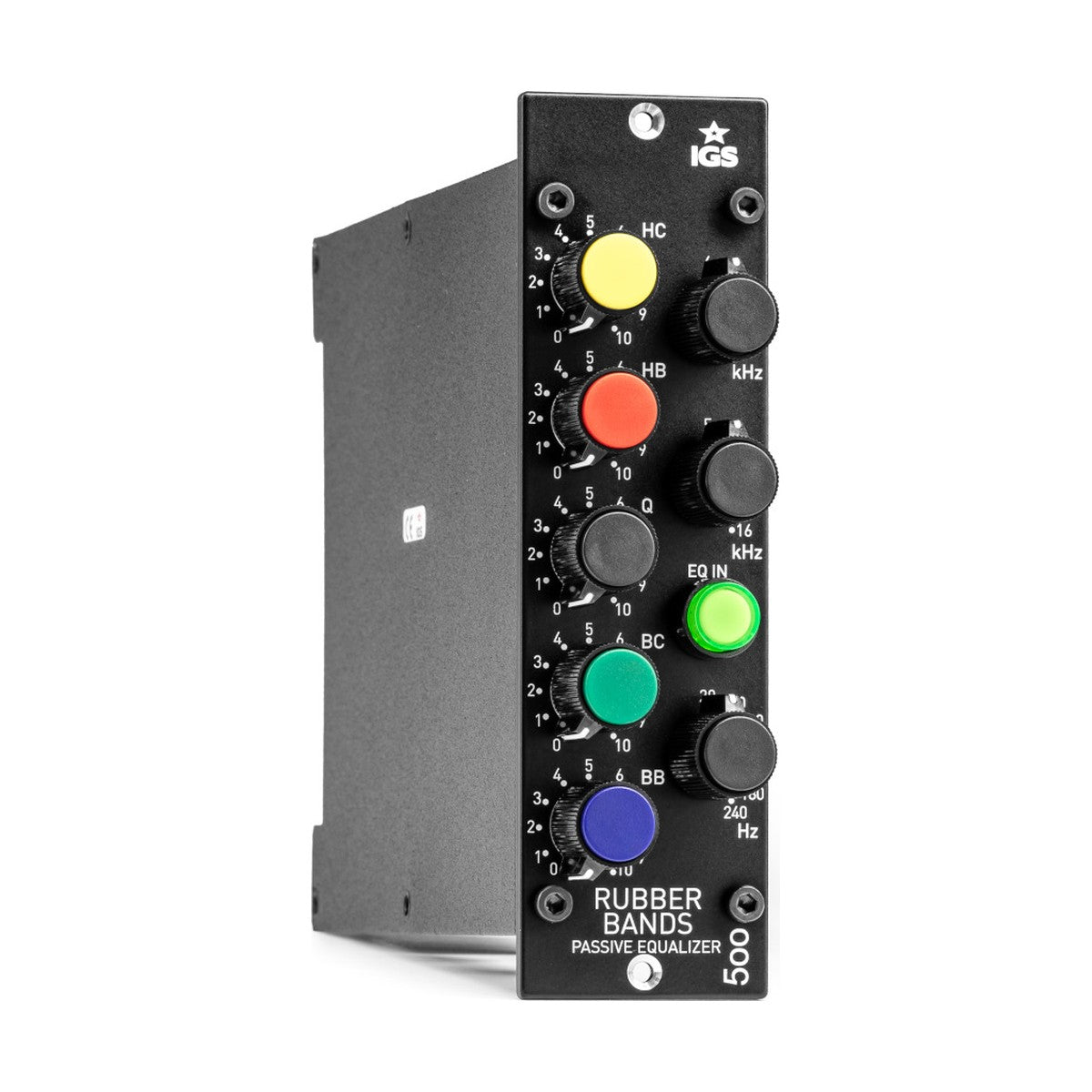
The RB 500 (Rubber Bands 500) is a passive equalizer in API 500 format, built by IGS Audio on the Pultec EQP-1A topology from the 1960s. Carnhill transformers on input and output balance the signal path and contribute the tonal colour associated with the British transformer school. The filtering section is fully passive – no active elements in the correction path means EQ curves with natural rounding and none of the artefacts of active or digital equalization. A discrete driver circuit recovers the gain lost in the passive network and delivers the signal to the output at 600 ohms impedance. Hard-wire relay bypass enables clean A/B comparison with the unprocessed signal. Frequency response: 5 Hz – 20 kHz ±0.1 dB, THD up to 0.1%, SNR above 99 dB.
Three sections – how they work independently and together
The RB 500 front panel provides two high-frequency sections and one low-frequency section, following the Pultec EQP-1A layout. The HB (High Boost) section offers frequency selection across 5, 6, 10, 12, and 16 kHz with continuous gain control and a Q selector. The HC (High Cut) section operates at 6, 10, and 20 kHz. Passive high-frequency correction in the Pultec style is asymmetric in the boost/cut relationship: boosting and cutting at the same frequency do not cancel each other linearly, which allows the simultaneous use of both to produce a shelf curve with an accentuated leading edge – a technique used on mix buses and mastering chains to open the top end without brightness fatigue. The low-frequency BBC section covers 20, 40, 60, 100, 180, and 240 Hz – the name references BBC console EQ curves that operated across a similar range. Correction range reaches ±15 dB with Q adjustable from 0.5 to 4.
Where passive Pultec-style EQ has an advantage over active correction
Passive Pultec correction on individual tracks and groups behaves differently from active EQ at equivalent nominal gain settings: the curve is wider at the base and narrows naturally toward the peak, meaning a boost at 10–16 kHz adds air without hardness, and a low-end boost at 40–60 Hz adds body without mud. The independent frequency selectors for the boost and cut sections in the low band – operating separately from each other – are the key differentiator from simplified clones: boosting at 20 Hz and cutting at 100 Hz simultaneously gives precise control over the bass silhouette without affecting the fundamental low-end floor. Maximum input level +20 dBu, output +22 dBu, power supply ±16 V, current draw 70 mA, weight 900 g.
KEY FEATURES
- Passive Pultec-style equalizer, API 500 format, mono
- Carnhill transformers on input and output
- Discrete driver circuit – recovers passive network insertion loss
- HB (High Boost) section: 5 / 6 / 10 / 12 / 16 kHz with Q control
- HC (High Cut) section: 6 / 10 / 20 kHz
- BBC (Low Boost/Cut) section: 20 / 40 / 60 / 100 / 180 / 240 Hz
- Independent frequency selectors for low-band boost and cut
- Correction range: ±15 dB
- Q: 0.5–4 (adjustable)
- Hard-wire relay bypass
TECHNICAL SPECIFICATIONS
- Type: passive band equalizer (Pultec EQP-1A style), API 500, mono
- Transformers: Carnhill (input and output)
- Input impedance: 1 kΩ (balanced, Carnhill)
- Output impedance: 600 Ω (balanced, Carnhill)
- Correction range: ±15 dB
- Q: 0.5–4
- Frequency response: 5 Hz – 20 kHz ±0.1 dB
- THD: up to 0.1%
- SNR: above 99 dB
- Operating level: +4 dBu
- Maximum input level: +20 dBu
- Maximum output level: +22 dBu
- Bypass: hard-wire (relay)
- Power supply: ±16 V
- Current consumption: 70 mA
- Power consumption: 3.5 W
- Weight: 900 g