Home Studio Acoustic Treatment: What to Fix First
Acoustic treatment changes what sound does inside your room. Soundproofing changes what leaks out of it. In a small home studio you want the first one, and you want it in this order: bass trapping in the corners, absorption at the first reflection points on the side walls, then one panel on the ceiling above the desk. Everything after that is refinement. Everything before that is usually foam squares glued on in the shape of a diamond, which decorates a wall beautifully and fixes roughly nothing.
The short version. Your room, not your monitors, is what makes the low end unreliable. Corners first, side walls second, ceiling third. Aim for 30 to 40 percent of your surfaces covered, not every square metre. And in a room under 15 square metres, a 5-inch monitor like the ADAM T5V at 177 euro will tell you more truth than an 8-inch one, because the room never gets a chance to develop the bass an 8-inch driver produces.
Jump to:
Why the room lies to you
Two things reach your ears when you play a mix. The sound straight from the monitors, and the same sound a few milliseconds later after it has bounced off a wall. Your brain adds them together. What you hear is not what came out of the speaker.
In a big room the reflections arrive late enough to be ignored. In a bedroom they arrive almost immediately, and the maths gets unkind.
The worst of it happens in the low end. Every room has resonant frequencies set by its dimensions, called room modes, and you can work out the lowest one on a napkin: sound travels at 343 metres per second, so a 4-metre wall resonates at about 43 Hz. Around that note the room is either shouting at you or swallowing the sound, depending on where you sit. Move your head half a metre and the bass changes character. That is a standing wave, and it does not care how much you paid for anything.
This is why a mix that sounded fat in the bedroom turns into a cardboard box in the car. You were not mixing the track. You were mixing the room, one dip and one boom at a time.

Treatment is not soundproofing
These two words get used as if they mean the same thing. They are almost opposites, and confusing them is the single most expensive mistake in this whole topic.
Acoustic treatment is light and porous. Mineral wool, dense foam, thick fabric. It absorbs sound energy inside the room and shortens the decay so you can hear detail. It does very little for your neighbours.
Soundproofing is heavy and sealed. Mass, air gaps, decoupled walls, a properly sealed door. It stops sound getting out. It does very little for your mix.
If your problem is a neighbour knocking on the wall at 23:00, panels will not save you, and no amount of them will. If your problem is that your kick drum disappears in the car, panels are exactly the answer. Buy for the problem you actually have, not the one that shares a syllable with it.
(Worth saying plainly: an egg carton is neither. It is an egg carton. It has been debunked for thirty years and it still turns up in photos on our shop floor, usually next to a mattress leaning on a wall.)

Fix it in this order
Most people start with the wall in front of the desk, because that is the wall they look at. That is the fourth job, not the first.
1. Corners, floor to ceiling. Low frequencies pile up where two surfaces meet, so corner traps do the heaviest lifting in the room. They also need real depth to work: a 5 cm panel starts absorbing around 500 Hz and does nothing to your 60 Hz problem. Thick, deep, in the corners, ideally behind you and behind the monitors.
2. First reflection points on the side walls. These are the two spots where sound from each monitor bounces off a side wall straight into your listening position. Finding them takes a friend and a mirror: sit where you mix, have them slide a mirror along the wall, and mark every point where a monitor is visible in it. That is where a panel goes. The trick is decades old, needs no measurement software, and is still the most useful five minutes you will spend on the room.
3. The ceiling above the desk. The ceiling is a giant flat surface directly between your monitors and your ears and it gets ignored because nobody looks up. A single panel hung above the desk, a cloud, cleans up the midrange more than most people expect.
4. The wall behind you. Sound travels past your head, hits the back wall and returns late. Absorb it, or scatter it with a diffuser if the room is deep enough. In a small room, absorb.
How much of it? The number worth remembering comes from Sound On Sound's beginner guide: a typical home studio needs 30 to 40 percent of its surfaces covered. Not all of them. Cover everything and you get a room with no life in it, where every reverb decision is wrong in the opposite direction. My first "studio" in 2007 was a wardrobe lined with duvets, and the EP I mixed in there sounds like a man broadcasting from inside a sofa.
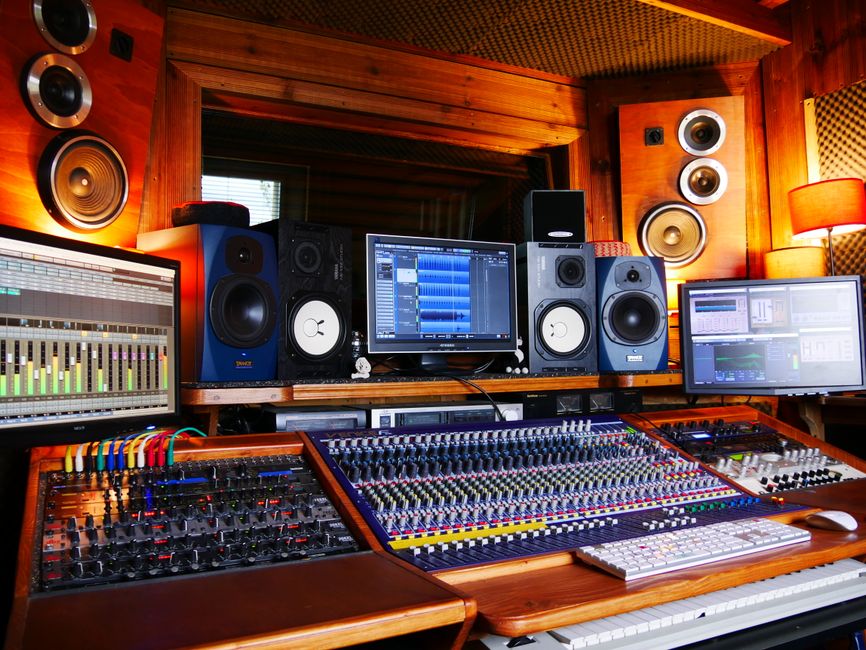
Three fixes that cost nothing
Before you buy a single panel, spend an afternoon on these. Free, one person and a tape measure, and in a small room they routinely beat the first 500 euro of treatment.
Get symmetrical. Your two monitors need the same acoustic surroundings. If the left one sits 20 cm from a wall and the right one is out in the open, your stereo image is already wrong and no plugin fixes it. Face the short wall, sit on the centre line, keep the distances equal on both sides.
Get off the wall, or get right against it. A monitor sitting 30 to 60 cm from the wall behind it produces a cancellation in the low mids, because the reflected wave comes back out of phase. Either pull the monitors well forward, or push them close and use the port compensation switch on the back if yours has one. The middle distance is the only genuinely bad choice, which is of course where every desk ends up by default.
Tweeters at ear height, an equilateral triangle. Monitors and your head form a triangle with equal sides, tweeters level with your ears, monitors angled in towards you. This is the most common thing we correct in the showroom, and it costs a stack of books and five minutes of humility. While you are down there, get the monitors off the desk surface if you can. A desk is a reflective board directly under the tweeter, and it does exactly what you would expect.
Before you spend anything, our guide to reading a studio monitor's frequency response covers what the graph on the box does and does not promise once a room gets involved.
Buy the room before the monitors
Here is the opinion I will hand you, and it costs us money to say it.
Treatment beats a monitor upgrade almost every time, per złoty spent. A customer came in with 8,000 zł monitors in a bare rented room, unable to trust the low end no matter what he did. Around 300 zł of corner bass trapping did more for his mixes than the entire speaker upgrade had. That is not a slogan, it is the actual sequence of events, and we sell monitors.
So when the room is small and the budget is finite, spend in this order: treatment, position, then monitors. And when you do reach the monitors, buy for the room you have.
Under 15 square metres, buy small. The ADAM T5V at 177 euro is a 5-inch nearfield reaching down to 45 Hz, already lower than most small untreated rooms reproduce honestly. An 8-inch monitor in the same room does not give you more information. It gives you more energy at exactly the frequencies your room handles worst.
If the room fights back, let the monitor measure it. The Genelec 8330A at 749 euro is part of the SAM range: you run the GLM calibration with a measurement mic and the monitor's DSP compensates for what your room does to the response. It genuinely works, with a caveat nobody selling panels will give you and nobody selling DSP will either. Correction can flatten a frequency response curve. It cannot remove a slap-back echo off the bare wall behind you, because that is a timing problem, not a level problem. DSP compensates for a room. It does not replace treating one.
When the room is genuinely ready. That is the moment for something like the PMC Result 6 pair at 2,527 euro, a compact nearfield with PMC's transmission line bass loading and no DSP in the signal path. In a treated room it is a revelation. In a bare 12 square metre bedroom it is an expensive way to hear your walls in higher resolution.

One more number: monitoring level matters more than monitor size. Around 85 dB your ears hear the spectrum most evenly. Mixing loud in a small room excites the modes, tires your ears, and starts a conversation with the neighbours that acoustic panels will not finish.
Renting, and not allowed to drill
Half the people who ask us about this live in a flat they do not own, and every guide on the internet cheerfully tells them to mount panels on four walls and hang a cloud from the ceiling. Useful advice, if you enjoy losing a deposit.
What actually works without a single hole in the wall:
- Freestanding traps in the corners. Panels on simple floor stands, or wedged between floor and ceiling with tension. Same absorption, no fixings, and they come with you when you move.
- A full bookshelf on the back wall. Irregular depths of books scatter mid and high frequencies effectively. It is the one piece of furniture that doubles as a diffuser, which is why studios have quietly stolen the trick for decades.
- Heavy curtains, hung away from the glass. A window is a big reflective plane. Thick fabric with an air gap behind it does real work above 500 Hz.
- A rug between you and the monitors. The floor is a first reflection point too, and it is the one you are allowed to cover in any tenancy agreement ever written.
- Move the desk to the short wall. Free, reversible, and often the biggest single improvement available to a rented room.
Old Warsaw flats add their own flavour: thick masonry, high ceilings, and a low end that behaves like it lives in a different building to the rest of the mix. Wielka płyta blocks do the opposite, with parallel concrete surfaces and a bass response that holds strong opinions.
When the room still lies
Sometimes the room cannot be fixed. You mix at night, or the flat is shared, or the only free space is a corridor with a window at one end. This is where headphones stop being a compromise and start being the honest option, because they take the room out of the signal path entirely.
Open-back is usually the better tool here, and the reason is the cup rather than the badge on it. A sealed cup puts a small resonant chamber around your ear, and that chamber makes the bottom octaves harder to read, which is where the mix that collapses in the car usually comes from. How much of that you get depends on the specific design: well-tuned closed-backs like the Neumann NDH 20 measure linear and are trusted daily. Open-back skips the chamber altogether and leaks in both directions, and that leak is the price you pay for the honesty. When closed-back is the right call, we covered it in the piece on closed-back headphones.
The Beyerdynamic DT 990 Pro 80 Ohm at 147 euro is the workhorse: open, analytical, forward in the treble once you learn it, and cheap enough to belong in every room whose acoustics are not improving this year. Step up and the Fostex T60RPmk2 at 609 euro puts a fourth-generation planar driver in a black walnut housing, semi-open, with the even response planars are bought for. At the top, the Audeze LCD-X at 1,265 euro is a 106 mm planar and about as close to a reference as a headphone gets, which is why it lands in mastering rooms that already have the acoustics sorted and use it as a second opinion.
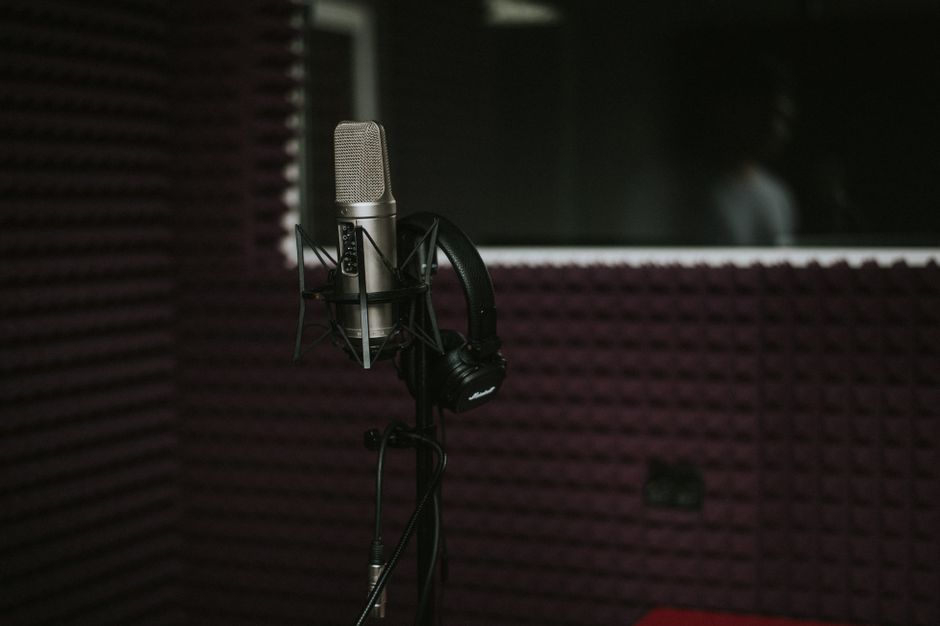
The honest caveat: headphones remove the room, and they also remove the crossfeed between your ears that makes a stereo image behave. Mix on them, then check on monitors, in a car, on a phone speaker. Choosing your first pair? The studio headphones guide goes through open, closed and semi-open properly.
If you would rather hear the difference than read about it, our Warsaw showroom exists for exactly this. Bring your own mix on a stick, listen to it in a room that has been treated properly, and hear how much of what you have been fighting was never the speakers. Or take a pair home on a free 30-day Test-Drive: short contract, real work in your real room, then you decide. Everything carries a 36-month warranty, 60 months on PMC and ADAM Audio, with a 30-day return window and free shipping over 900 zł across Poland. We ship to every EU country.
Straight answers
What is acoustic treatment?
Acoustic treatment is the use of absorbent and scattering materials inside a room to control reflections, reverberation time and low-frequency build-up. It uses bass traps in the corners, absorption panels at reflection points and diffusers on larger surfaces. Its job is to make what you hear match what your monitors are actually producing.
Do you need acoustic treatment?
If you mix, master or record in the room, yes. Every room colours sound, and a small one colours it heavily below roughly 300 Hz, which is where most mix decisions go wrong. If you only track vocals through headphones and mix elsewhere, you can get away with a lot less. Basic corner trapping is the point where results stop being subtle.
Where to start with acoustic treatment?
Start in the corners with deep bass traps, floor to ceiling, because low frequencies concentrate where surfaces meet and cause the biggest errors. Then treat the first reflection points on the side walls, then hang a panel above the desk. The wall you look at is not the first priority, even though it feels like it should be.
Where should I put acoustic treatment?
Corners first, then the two side-wall points where sound bounces from the monitors into your listening position, then the ceiling above the desk, then the wall behind your head. Find the side-wall points with the mirror trick: sit in your mixing position, have someone slide a mirror along the wall, and mark every spot where a monitor is visible.
How much acoustic treatment do I need?
For a typical home studio, roughly 30 to 40 percent of the room's surfaces, weighted heavily towards the corners and the first reflection points. Panel thickness matters as much as quantity: thin panels only absorb high frequencies, so if the problem is boomy bass, depth in the corners does more than extra panels on the walls.
Is there such a thing as too much acoustic treatment?
Yes. Covering every surface with absorption gives you a dead room with no high-frequency life, which is unpleasant to work in and pushes you towards adding too much reverb in the mix. Keep some scattering and some live surfaces, especially behind the listening position. Aim for controlled, not silent.
So: fix the corners, find the reflections, cover the ceiling above your head, and stop buying speakers to solve a problem the walls are causing. Your room will never be a mastering suite, and it does not need to be. It needs to stop lying to you. Do that and the next mix travels, which is the only test that has ever mattered. And if you are still measuring your walls at one in the morning, that is not room treatment any more, that is Gear Acquisition Syndrome wearing a tape measure as a disguise.
About the author
Michał Kaniuszkiewicz is a content manager and SEO specialist at Wired Tunes. He creates and optimizes content that helps readers find useful information about music, gear, and sound. Beyond his editorial work, he has been making music for 8 years in hip-hop, pop, and electronic genres — giving him insight into the subject not just from an SEO perspective, but from the inside, as a practicing musician and producer. This experience allows him to create content that's equally useful and clear for both beginners and experienced listeners and music creators.
Read next


- Studio Monitor Placement, How to Set Up Your Monitors. Panels only pay off once the monitors stand in the right place, and that part is free.
- Active Studio Monitors, How to Choose the Right Pair. If the room is sorted and the monitors are next, this is how to pick a pair for its size.
- How to Record Vocals at Home? A Complete Step-by-Step Guide. The other half of a treated room: how to actually track in it once the panels are up.