The Best Podcast Microphone in 2026: What to Buy and Why
The best podcast microphone for almost everybody is a dynamic cardioid microphone that you speak into from about a hand's width away. Dynamic, because it ignores most of the room. Cardioid, because it listens forwards and not at your radiator. Close, because distance is the single thing that separates a podcast that sounds professional from one that sounds like it was recorded in a stairwell. Everything after this paragraph is detail, budget and personal taste.
Your room is on the recording whether you invited it or not, and it never brings anything. A good podcast mic is mostly a device for leaving the room out of the conversation.
The short version. One person, ordinary room, wants this sorted today: the RODE PodMic USB at 191 euro, because it works over USB now and over XLR later. Tightest budget that is still honest: the RODE PodMic at 80 euro plus an interface. Quiet, treated room and you want detail: the RODE NT-USB+ at 144 euro. Everything here is in stock and comes with a free 30-day Test-Drive.
Jump to:
Dynamic or condenser: your room decides
This is the first fork in the road and most people get pushed the wrong way down it by a spec sheet.
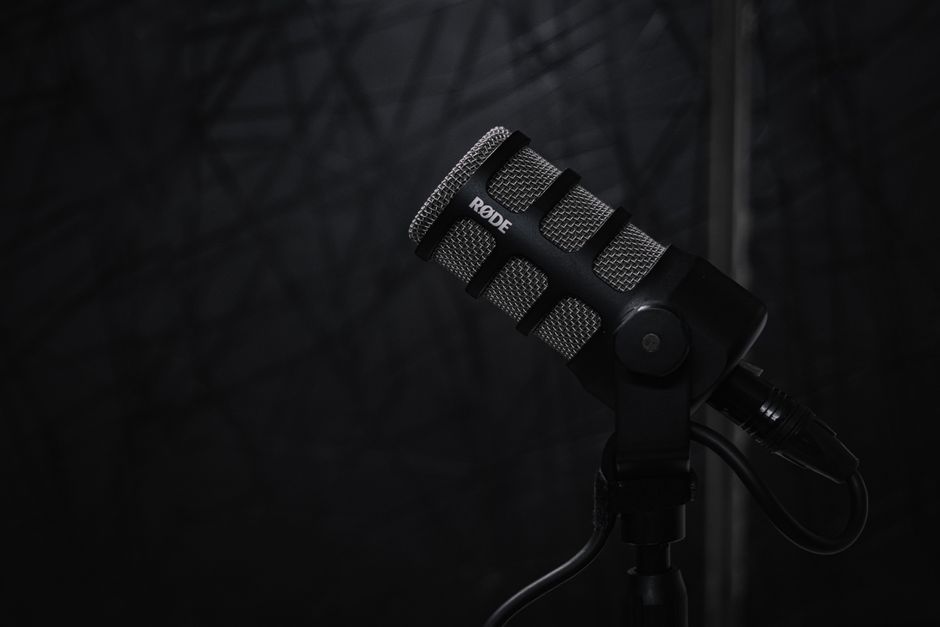
A dynamic microphone needs sound pressure to move a coil. That makes it relatively deaf to anything quiet and far away, which describes almost everything you do not want: the fridge, the street, the reflection off the wall behind you, your neighbour rediscovering drilling. It is the reason broadcast studios have used dynamics for sixty years while the rest of the industry chased sensitivity.
A condenser microphone uses a charged diaphragm and a preamp, so it hears detail a dynamic misses. It also hears the fridge, the street, the reflection and the drilling with exactly the same enthusiasm. Shure puts it plainly: condensers respond better to high frequencies, which is a gift in a quiet room and a liability everywhere else.
So the honest rule of thumb. Untreated room, hard floor, desk against a window, anyone else in the flat: dynamic. Treated room, or a small space with soft furnishings, curtains and a rug, and you record when the building is asleep: condenser, and you will hear the difference in the top end immediately.
Buying a more expensive condenser to fix a boxy-sounding recording is a classic mistake. Same room. Same chair. Same wall two feet behind your head. You arrive at the same recording with a lighter wallet, which is the most expensive way anyone has ever proved that microphones do not treat rooms. If you want the longer version of this argument, the condenser versus dynamic guide takes it apart properly.

USB, XLR, or the one that does both
USB means the microphone contains its own preamp and converter. One cable to the computer, no interface, no phantom power, no gain staging to get wrong. You are recording within ten minutes of opening the box. The catch is that you own one channel forever: a second person means a second USB mic, and most operating systems will start negotiating with you about that.
XLR means the microphone is only a microphone, and the preamp and converter live in an audio interface. More boxes, more cable, more money on day one. In return you get a chain you can upgrade one piece at a time, two or four inputs for guests, and a microphone that will outlive four computers. If phantom power is the part that worries you, we wrote a whole post on the mysterious blue light of shame, and the short answer is that dynamics do not need it at all.
Then there is the hybrid, which quietly ended this argument for solo podcasters. One microphone, both sockets. USB today with the laptop, XLR in a year when there is an interface on the desk and a co-host in the chair. You buy the capsule once and change your mind about the rest later, which is the cheapest kind of future-proofing there is.
For a two-person show recorded in one room, skip straight to XLR. Two USB mics into one computer is a solvable problem, and solving it every single week is not how you want to spend your Sundays.

Five worth buying in 2026
All five are on our shelves right now, priced in euro, and they are ordered by what they are for rather than by a score out of ten. There is no best microphone in the abstract. There is the one that suits your room, your budget and the number of people in the chair.
1. The cheapest honest answer: RODE PodMic, 80 euro. Dynamic, cardioid, built for voice, with an internal pop filter and an internal shockmount so plosives and desk knocks mostly stay out of the recording. It has an integrated swing mount, which means it goes straight onto a boom arm without an adapter you did not know you needed. It is XLR only, so budget for an interface. At this price that is still the least you can spend and end up with something that sounds like a podcast rather than a phone call.
2. When it also has to leave the house: sE Electronics V7, 84 euro. A supercardioid handheld dynamic with an aluminium windscreen and an internal shock mount. Supercardioid means an even narrower pickup angle than the PodMic, so it rejects more of the room, and being a handheld it survives interviews, live events and being handed to a guest who has never held a microphone before. Slightly more upper-mid bite than the PodMic. If half your episodes happen away from the desk, this is the one.
3. The one most people should buy: RODE PodMic USB, 191 euro. The same broadcast-dynamic idea with both a USB-C and an XLR output, so it is a complete recording setup today and a normal studio microphone the day you outgrow that. Onboard DSP by APHEX gives you a compressor, a noise gate, a high-pass filter, the Aural Exciter and Big Bottom, all applied before the sound reaches your software. There is a headphone output with zero-latency monitoring, which matters more than it sounds: hearing yourself while you talk fixes mic technique faster than any article can, including this one.
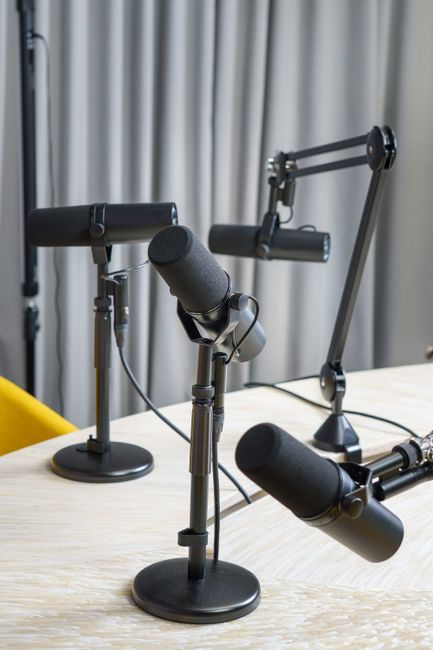
4. For a quiet room and a detailed voice: RODE NT-USB+, 144 euro. A USB condenser with RODE's Revolution preamp, a detachable pop shield, zero-latency headphone monitoring and the same APHEX processing on board. In a treated room it gives you air and detail that no dynamic on this list can reach. In an untreated room it gives you air, detail, the fridge and next door's television. Be honest about which room you own before you order it.
5. The one everybody asks about: Shure SM7dB, 642 euro. The SM7 capsule that has been on air since the 1970s, with the thing everyone used to buy separately built in: an active preamp offering an extra 18 or 28 dB. The classic SM7B is famously quiet and needs a strong preamp or an inline booster to wake up, and half the bad SM7B recordings on the internet are really underpowered ones. This version removes that failure mode entirely. Bass rolloff and presence boost switches, internal air suspension, and a sound you have already heard on a thousand shows.
The microphone is a third of the chain
Every buying guide sells you a microphone and stops. Here is the whole bill, because a microphone on a desk with nothing else is a paperweight with a grille.
An interface, if you went XLR. The Audient iD4 MKII at 147 euro has one of the console-grade Audient mic preamps, a JFET instrument input, two headphone outputs and USB-C. Two headphone outputs is the detail that matters for interviews: your guest can hear themselves too, and a guest who can hear themselves stops shouting.
A boom arm. Not a luxury. A desk stand puts the microphone where the desk is, which is usually too low and too far away, and it transmits every keyboard press straight up the pole. The RODE PSA1+ at 100 euro takes anything from 94 g to 1.2 kg, has fully damped springs, a desk clamp and a threaded mount in the box, and routes the cable internally so nothing dangles into the shot.
Headphones, closed-back. Anything open-back will leak into the microphone and you will be re-recording. This is the least glamorous purchase in podcasting and the one people skip most often.
So the realistic starting bill for an XLR setup: PodMic at 80, iD4 MKII at 147, PSA1+ at 100. That is 327 euro for a chain that will still be working in ten years, and every piece of it can be upgraded on its own. If you want the mechanics of getting all this into your computer, the connection guide covers it step by step.

Two people, one room
Almost every guide answers the solo case and goes quiet on the interesting one, which is two people at one table. It behaves differently and it catches people out.
The problem is bleed. Your co-host's voice arrives in your microphone slightly later and slightly duller than it arrives in theirs, and when you edit the two tracks together the overlap does strange, hollow things to both voices. You cannot fix it afterwards. You can only stop it happening.
Three things that work. Point the microphones away from each other. Cardioid rejects most strongly from behind, so if the null of your mic faces your guest, most of their voice never gets in. Get closer. Halving the distance to your own mic buys you roughly six more decibels of your own voice against everything else in the room. Use dynamics. This is the case where the extra sensitivity of a condenser stops being a feature.
Two PodMics, one iD4 MKII and two boom arms is the standard, boring, correct answer to a two-person show in an ordinary room, and it comes in under 500 euro. Recording remote guests instead? Then each of you records locally and you sync afterwards, and nothing in this section applies to you.
When not to buy a new microphone
Here is the one strong opinion, and it costs us the more expensive sale.
Distance beats price. An sE V7 at 84 euro, spoken into from ten centimetres, will beat a Shure SM7dB at 642 euro used at arm's length. Not slightly. Obviously, on the first listen, to somebody who does not know what a microphone is. Close in, your voice dominates everything else that is happening in the room, and the proximity effect adds a low-end weight that people spend money on plugins trying to fake. At arm's length, you are recording the room and your voice is a guest in it.
So before you upgrade, do this. Move the microphone to a hand's width from your mouth, slightly off to one side so plosives pass by rather than into it. Turn the gain down to compensate. Record a minute. If that fixes it, you never needed a new microphone, and I would rather tell you that now than sell you 642 euro of the same problem.
The other honest one: if you already own a competent dynamic mic and your recordings still sound thin, the fault is the room or the technique, not the capsule. A second microphone has never fixed a first microphone. I own six and can confirm this personally, which tells you more about my judgement than about the gear.
A microphone is the hardest thing in this shop to buy from a photograph, because what you are actually choosing is how your own voice sounds coming back at you. Our Warsaw showroom on Nowogrodzka has these plugged in and waiting, so you can talk into all five in twenty minutes and find out which one flatters you. Or take one home on a free 30-day Test-Drive: short contract, real episodes, your own room, then decide. Everything carries a 36-month warranty and a 30-day return window, and we ship to every EU country. Our sales lead Andrei has fifteen years in production and mixing, and he has opinions about mic technique that he will share whether or not you ask.
Straight answers
What microphone do most podcasters use?
A cardioid dynamic microphone, connected either over USB or over XLR into a small audio interface. The specific models change every couple of years, but the category does not: broadcast studios settled on dynamics decades ago because they reject rooms, and podcasting inherited that decision. The RODE PodMic and the Shure SM7 family are the two you will see most often on video.
What mic does Joe Rogan use for his podcast?
The microphone most associated with that show is the Shure SM7B, and it is fair to say it drove a decade of podcast microphone sales single-handedly. Worth knowing before you copy it: the SM7B is a very quiet microphone that needs a strong preamp or an inline booster to sound right. The SM7dB at 642 euro is the same capsule with that preamp built in, which removes the most common way people get this microphone wrong.
Is the Shure SM7B the best podcast mic?
It is an excellent microphone and it is not automatically the right one for you. It needs roughly 60 dB of clean gain, which many budget interfaces cannot supply, so the total cost is higher than the price tag suggests. If you want that sound without the gain problem, the SM7dB solves it internally. If your room is untreated and your budget is under 200 euro, a PodMic USB at 191 euro will get you closer to a good-sounding episode than a starved SM7B will.
What is the best value microphone for podcasting?
The RODE PodMic at 80 euro if you already have an audio interface, and the RODE PodMic USB at 191 euro if you do not, because it replaces the interface entirely and still has an XLR output for later. Both are dynamic and cardioid, which is the combination that makes an ordinary room sound acceptable without spending anything on acoustic treatment.
Do you need two microphones for a podcast?
Only if two people are in the same room. One microphone shared between two people puts both voices on one track at different volumes, and no amount of editing separates them afterwards. Remote guests do not need a second microphone at your end: they record locally on their own and you sync the files. For two people at one table, two microphones into a two-input interface is the setup that works.
What is the best podcast microphone for a noisy environment?
A dynamic with a tight pattern, used close. The sE Electronics V7 at 84 euro is supercardioid, so it hears less of the room than a standard cardioid does, and it is built as a handheld for exactly this kind of situation. Combine it with a distance of about ten centimetres and most background noise drops far enough down to stop being a problem.
So: dynamic unless your room has earned a condenser, close enough that your mouth is a hand's width away, and a boom arm so it stays there. That is ninety percent of it, and the remaining ten percent is the part you can only sort out by talking into a few and listening back. If you are still watching microphone shootout videos at midnight while a perfectly good mic sits on your desk in its box, that is not research any more. That is Gear Acquisition Syndrome, and the first symptom is a browser with fourteen tabs open and no episode published.
About the author
Michał Kaniuszkiewicz is a content manager and SEO specialist at Wired Tunes. He creates and optimizes content that helps readers find useful information about music, gear, and sound. Beyond his editorial work, he has been making music for 8 years in hip-hop, pop, and electronic genres — giving him insight into the subject not just from an SEO perspective, but from the inside, as a practicing musician and producer. This experience allows him to create content that's equally useful and clear for both beginners and experienced listeners and music creators.
Read next
- XLR vs USB Microphone: Which One Do You Actually Need?. The full version of the decision this article only summarised, including what changes once a second person joins the table.
- The Best Audio Interface, and How to Actually Choose One. Go XLR and this is the box that sets your noise floor and how many voices you can record at once.
- Closed-Back Headphones, When and Why to Use Them. The purchase podcasters skip most often, and the one that decides whether you record the episode twice.