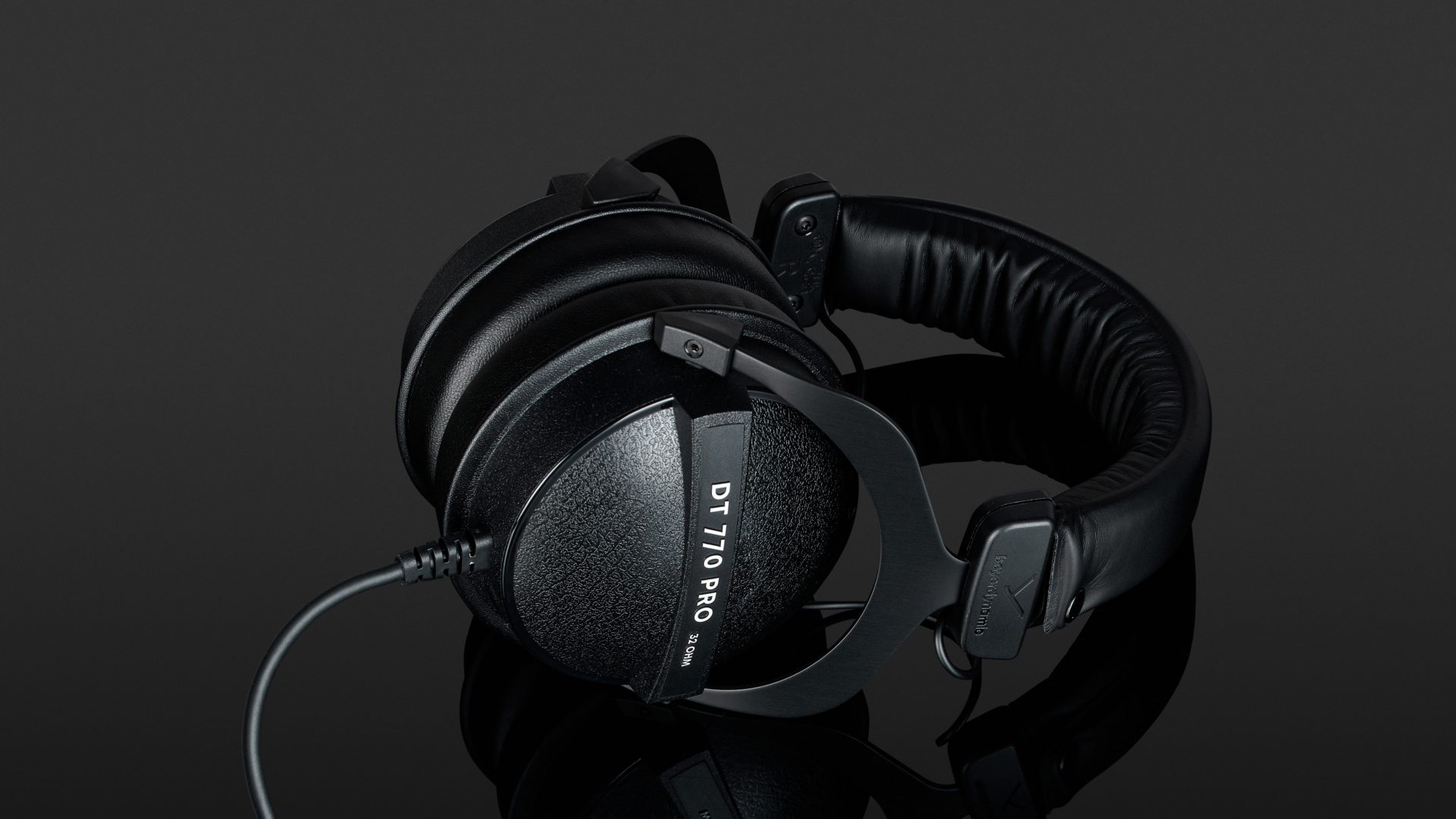
Beyerdynamic DT 770 PRO: 32, 80 or 250 Ohm
The Beyerdynamic DT 770 PRO comes in three versions that differ only in impedance: 32, 80 and 250 ohm. They cost €148, €147 and €149, so the spread across all three is two euros. This is not a decision about money. It is a decision about what you are plugging them into, and Beyerdynamic has politely left that question to you.
Short version. Phone, laptop or console: 32 ohm. An audio interface and these are your main tracking headphones: 80 ohm, and that covers most people. A strong headphone output or a dedicated amp: 250 ohm. Would rather not think about it at all: PRO X ships in one version with a detachable cable.
Jump to:

Three versions, one price
Impedance is the resistance the headphones present to the signal. Higher impedance means less current flows at the same voltage, so the source has to swing more voltage to reach the same loudness.
And here is the misunderstanding we hear across the counter most weeks. Impedance on its own settles nothing. What matters is the pair: impedance and sensitivity, meaning how many decibels the headphones produce from a given power or voltage. There are 250-ohm designs with high sensitivity that go loud off almost anything, and 32-ohm designs that want more headroom than a laptop has. That is why "250 ohm needs an amp" is a convenient line rather than a true one, and why the next section takes it apart properly.
In practical terms, inside the DT 770 family the split works like this.
| Version | What you plug into | Typical use | Price |
|---|---|---|---|
| 32 ohm | Phone, laptop, console, tablet | Working on the move, editing on a laptop, gaming | €148 |
| 80 ohm | Any audio interface or studio gear | Tracking, desk monitoring, podcasting | €147 |
| 250 ohm | Strong headphone output, amp, console | A fixed desk with a headphone amp | €149 |
| 48 ohm (PRO X) | All of the above | One version instead of three decisions | €199 |
Notice one thing, because it is the point of the whole article. Two euros between the versions means nobody is cutting corners on any of them. There is no cheap-and-worse option. There is one version that suits your gear and two that will underperform while costing the same. The most common mistake we see: someone takes the 250 ohm because it sounds the most professional, plugs it into a laptop, and wonders why it is quiet.
Does 250 ohm need an amp
The answer is that it usually does not need a separate amplifier, but it does need an output with voltage headroom.
That distinction matters. A headphone amplifier is another box on the desk. A decent headphone output is something you already have inside a €148 interface. The Audient iD4 MkII drives 250-ohm headphones without anything else in the chain, and that describes most home studios.
Where 250 ohm will genuinely bite: the headphone jack on a laptop, a phone through an adapter, the output on a budget keyboard. The symptom is unmistakable. Volume is at maximum, it is still not loud enough, and the sound goes flat because the source cannot drive the drivers properly.
The reverse problem gets discussed far less often. Plug 32 ohm into a strong studio output and it can be too loud at the first click of the knob. All your useful adjustment lives in the bottom fifth of the dial, and setting a genuinely quiet monitoring level becomes guesswork. Nothing is broken. It is just irritating for years.
If you are still assembling the chain and are not sure what your output can do, start with how to choose studio headphones, which takes apart the whole signal path rather than the label on the box.

DT 770 or DT 990
Google suggests this comparison on its own, and customers ask it at the counter. The difference is not one of class. It is construction: the DT 770 is closed-back, the DT 990 is open-back.
A sealed cup buys isolation in both directions. You do not hear the room, and the microphone does not hear your headphones. That makes it the sensible choice for tracking vocals, because otherwise the backing leaks into the mic and stays in the recording permanently. That same sealed cavity also adds resonances that make the low end harder to judge. How much depends on the specific design rather than on the category: well-tuned closed-backs measure linear.
An open cup lets sound out and lets the room in. The stage widens and long sessions tire you less. The price is paid twice: everyone nearby hears your work, and a live microphone in the same room is off the table.
The rule that settles most cases: recording, go closed. Mixing with nobody to disturb, go open. Either way, make the final call on bass using monitors in a treated room, because no headphones will show you how the track behaves in a space. We take that comparison apart properly in open-back vs closed-back headphones.
PRO or PRO X
Here is the part no ranking mentions, and it quietly solves the entire problem this article is about. The newer PRO X ships in one version: 48 ohm. Beyerdynamic removed the choice, because 48 ohm is the compromise that works off a laptop and off an interface.
Alongside that comes a detachable mini-XLR cable. That sounds like a detail right up to the day you roll a chair over the lead on the older model, where the cable is hard-wired. At that point it is the difference between buying a cable and booking a repair.
PRO X costs €199 against €147, so about fifty euros more. Whether that is worth it turns on one question: do you know what you are plugging into. If you do, the classic PRO in the right version gives you the same thing for less. If you do not, or the headphones will move between a laptop, an interface and a console, PRO X takes the decision and the risk of getting it wrong off your hands.
Seven pairs from the shelf
All in stock, prices as they stand today, ordered by the job rather than by the badge.
1. DT-770 Pro 32 ohm, €148. The mobile version. Phone, laptop, console, anything without a proper headphone output. If your setup is a computer and nothing else, this is your version and there is nothing to agonise over.
2. DT-770 Pro 80 ohm, €147. The default studio choice and the biggest seller of the three. It works off any audio interface and behaves respectably off a computer too. If you are not sure which to take, take this one.
3. DT-770 Pro 250 ohm, €149. For a desk that does not move and an output with headroom. In that setup the volume control spreads across the whole range instead of living in the first few percent.
4. DT-770 Pro X 48 ohm, €199. The new generation: one impedance that fits everywhere, plus the detachable cable. You are paying for the absence of a decision, and for a frayed lead not meaning the end of the headphones.
5. DT-990 Pro 80 ohm, €148. The open-back twin at the same money. For mixing and long listening, provided nobody is bothered by it and there is no live microphone nearby.
6. DT-900 Pro X, €218. Open-back, new generation, detachable cable as well. A step up from the DT 990 if an open design is going to be your main working pair.
7. DT-1990 Pro MKII, €448.61. The flagship. Three times the price of the DT 990, with two sets of pads that change the tonal balance. It earns its place when headphones are your main decision-making tool rather than a second opinion after the monitors.
And one item from outside the family, because a conversation about impedance is incomplete without it: Audient iD4 MkII, €148. An interface whose headphone output has headroom. Buy it alongside the headphones and the separate-amplifier question stops existing.

What these will not fix
We sell these, so take this section in the spirit it is offered.
They will not fix your room. Headphones bypass the acoustics of the space, which sounds like an advantage and genuinely is one while you work. The catch is that your listeners do not bypass it. A mix built entirely on headphones can fall apart in the first car you play it in, and that is not the headphones' fault.
They will not fix a weak source. Plug them into an output that hisses or runs out of level and a better pair will simply show you the hiss more clearly. The order is the opposite of the intuitive one: a decent output first, better headphones second.
And here is our opinion, which you are free to argue with. If you already own the 80 ohm DT 770 and you are eyeing the DT 1990 PRO MKII, that is a €300 gap. That money buys a solid interface or the first serious piece of room treatment, and either will change your recordings more than moving up a tier within the same headphone category. A flagship earns its place once the rest of the chain is sorted, not instead of it.
And do not buy 250 ohm to be on the safe side. It is the single most common reason someone comes back a week later asking why everything is so quiet. The safe version is 80 ohm, because it works everywhere, not the one with the biggest number on the box.
Our showroom is at Nowogrodzka 6A/102 in Warsaw, and with three versions of one model the fastest route to an answer is to arrive with your own interface or laptop and hear which version behaves properly with your gear. Selected equipment also comes with a free 30-day Test-Drive, everything carries a 36-month warranty, and we ship to every EU country.
Straight answers
Are Beyerdynamic DT 770 PRO headphones good?
They have been a studio default for decades, which is the useful part of the answer. The build is repairable down to the pads, the headband and the drivers, so a pair survives years of daily work. The closed-back design isolates well enough to track vocals next to a live microphone. The honest caveat is that the sealed cup makes the low end harder to judge than it is on monitors, so treat them as a detail tool rather than the final word on bass.
Is 80 or 250 ohm better?
Neither is better in the abstract. 80 ohm works off any audio interface and off a computer, which makes it the safer default. 250 ohm suits a fixed desk with a strong headphone output or a dedicated amplifier, where the extra impedance gives you finer control across the volume range. Since the two cost €147 and €149, pick by what you plug into rather than by price.
Do DT 770 PRO need an amp?
In most cases no. The 32 and 80 ohm versions run off a computer and off any audio interface. The 250 ohm version needs an output with voltage headroom, but that does not have to be a separate amplifier: a decent headphone output on an interface such as the Audient iD4 MkII handles it. Impedance alone does not settle the question, because sensitivity and the actual output voltage of your gear matter just as much.
Beyerdynamic DT 770 Pro vs 990, which one should I get?
The DT 770 is closed-back and the DT 990 is open-back, and that single difference decides it. Closed-back isolates in both directions, so it is the one for recording with a microphone in the same room. Open-back gives a wider stage and is easier on long sessions, but it leaks sound and cannot be used near a live mic. At €147 and €148 the price is not part of the decision.
What is the difference between DT 770 PRO and DT 770 PRO X?
Two things. The PRO X comes in a single 48-ohm version, which removes the choice between 32, 80 and 250 ohm entirely. The second difference is a detachable mini-XLR cable instead of a hard-wired lead, so a damaged cable is something you replace yourself. The PRO X costs €199 against €147 for the classic 80 ohm version.
Which DT 770 impedance should I buy for my audio interface?
For most interfaces the 80 ohm version is the right default, and it will not run out of level on anything current. Choose 250 ohm if your interface has a headphone output with real headroom and you want finer control at quiet listening levels. Choose 32 ohm only if the headphones will spend most of their life on a laptop or a phone rather than on the interface, because a strong studio output can make 32 ohm awkwardly loud at the bottom of the dial.
Check what your output can actually do, then pick the version. Two euros of price difference means a wrong choice costs you no money at all, just a few months of quiet monitoring and a nagging suspicion that something is off with the headphones. And once your first proper pair has you catching a chair creak and a passing plane in other people's recordings, welcome to the club. There is no way out, and the subscription is paid in replacement earpads every couple of years.
Read next
- Closed-back headphones, when and why. When isolation is a requirement rather than a preference.
- The best audio interface. The other half of the equation: what actually supplies the voltage.
- Your first studio, start here. What else belongs on the desk before the headphones matter.