VERTIGO SOUND
VERTIGO SOUND VSC-3 Compressor
Choose options
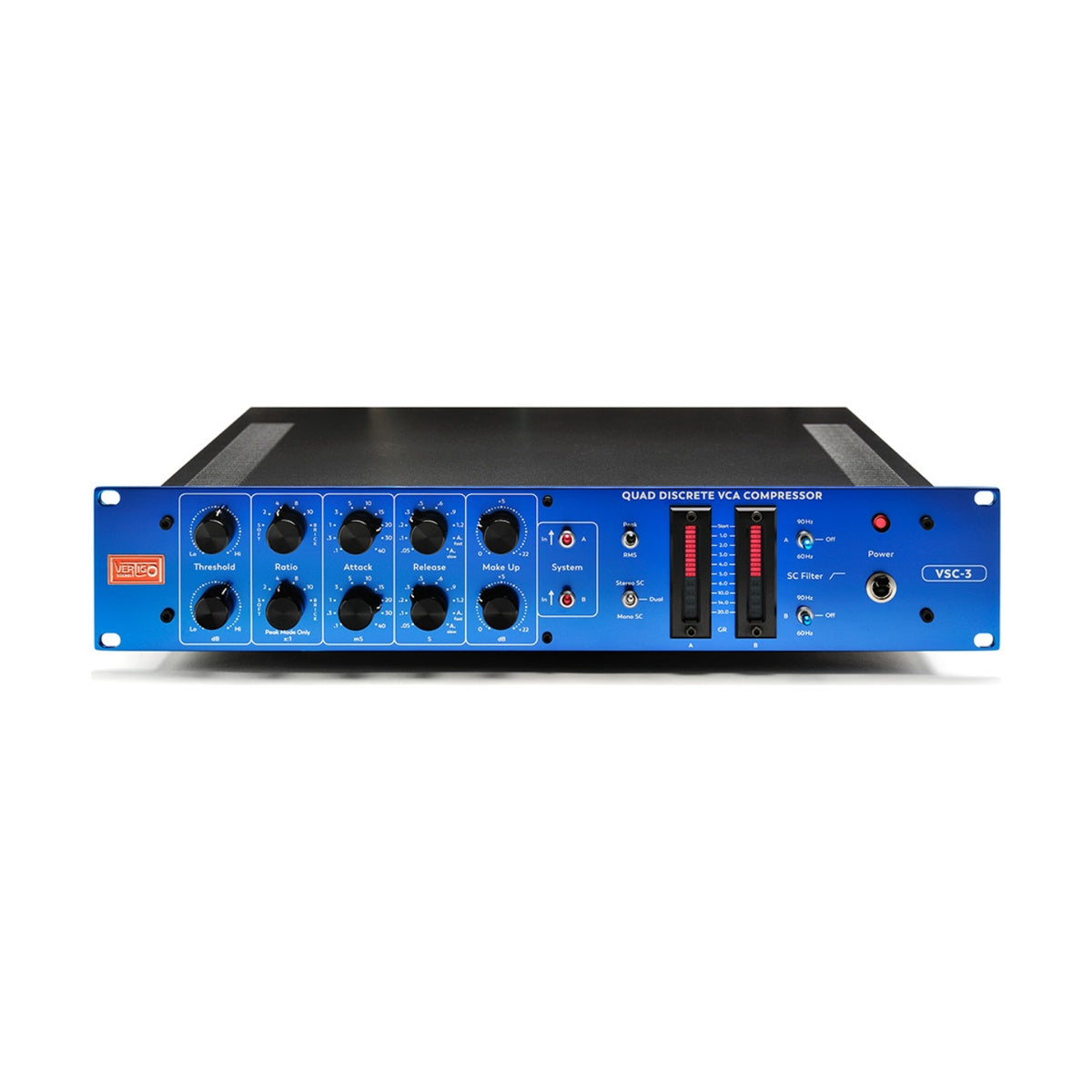
Vertigo Sound VSC-3 is a two channel compressor built around four discrete 1979 VCAs: one in the audio path and one in the sidechain of each channel. The topology nods to the best VCA compressors of the seventies and eighties, while the signal path itself is modern and mastering grade.
Soft TipToe: compression you do not hear starting
The most exposed moment in compression is the threshold crossing, where the ear catches something switching on. Soft mode is not a conventional soft knee. It is a level dependent ratio that rises smoothly from 1:1 up to 8:1 as the signal grows, which keeps the onset of gain reduction inaudible and brings the character close to classic opto and variable mu designs. For firmer work there are 2:1, 4:1, 8:1, 10:1 and Brick at 40:1, and the ratio switch compensates for loudness, so you compare tone rather than level.
A sidechain that does not pump on the kick
When the compressor starts breathing along with kick and bass, you engage the SC filter. Both curves are deliberately gentle, so the low end is not cut out of the detector entirely, only processed less. Stereo SC mode uses both independent detectors, and the higher peak on either channel triggers reduction on both, so the VSC-3 responds to out of phase signals without shifting the stereo image. Mono SC narrows the image but glues a subgroup harder. The detector itself switches between Peak and RMS.
KEY FEATURES
- Four discrete 1979 VCAs across two channels
- Soft TipToe mode with a ratio rising from 1:1 to 8:1
- Ratio settings: 2:1, 4:1, 8:1, 10:1 and Brick at 40:1
- Loudness compensation when changing ratio
- Ten attack times from 0.1 ms to 40 ms
- Ten release times including Auto fast and Auto slow
- SC filter with two gentle curves in each sidechain
- Operating modes: Stereo, Dual Mono and Mono SC
- Detector switchable between Peak and RMS
- Non linear gain reduction meter with fine resolution to 6 dB
- Gold plated stepped switches for ratio, attack and release
- True hardwire bypass of the whole processor
TECHNICAL SPECIFICATIONS
- Threshold range: -22 dBu to +23 dBu with a zoom between -6 and +10 dBu
- Make up gain: up to +22 dBu with a zoom between 0 and +6 dBu
- Dynamic range: 117 dB
- Frequency response: 10 Hz to 70 kHz (-3 dB)
- Maximum input level: +22 dBu
- Maximum output level: +27 dBu into 600 Ohm, balanced floating
- Signal to noise ratio at +6 dBu: 97 dB (20 Hz-20 kHz, unweighted, RMS)
- Noise: -91 dBu (20 Hz-22 kHz, unweighted, RMS) at 0 dB unity gain
- Crosstalk between channels: better than 100 dB at any frequency
- Cinemag transformer input, That 1646 or Burr Brown output
- Power consumption: max 12 W
- Mains voltage: 115 V or 230 V