AEA
AEA R92
Configurer
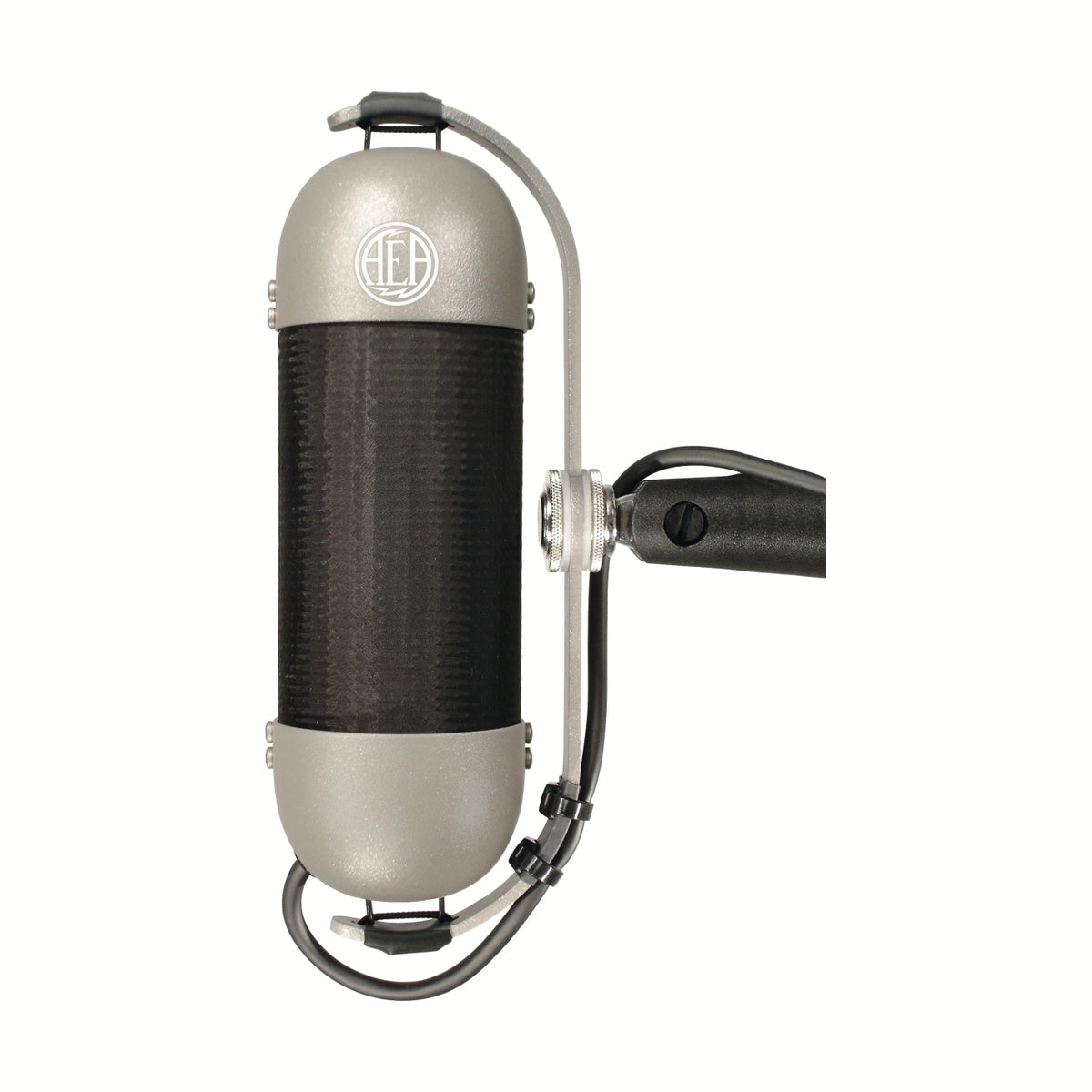
AEA R92 is a passive ribbon microphone in a side-address format, engineered specifically for close-miking applications. The Big Ribbon element — 1.8-micron aluminum at 59.7 mm × 4.7 mm, with the same 16.5 Hz tuning and transformer as the flagship R44 — is housed in a new acoustic motor that suppresses proximity effect and delivers a flat tonal balance at 6–12 inches from the source. The pill-shaped body with its integrated shock mount and 360° swivel yoke distinguishes the R92 from most passive ribbon designs that require a separate shockmount and stand adapter.
Two Voices from One Ribbon — Front and Back as Distinct Tonalities
The R92 is the only passive AEA ribbon with deliberately asymmetric frequency voicing between the two lobes of its figure-8 pattern. The front face (marked by the AEA logo) is the "crisp" side — extended, clear top-end with pronounced midrange definition, suited for electric guitar, brass, and percussion where transient attack detail is essential for mix clarity. The back face is the "smooth" side — a classic gentle high-frequency rolloff reminiscent of the RCA 44, which softens harsh transients and handles aggressive sources more flatteringly. Both lobes share the same ribbon element and transformer; the tonal difference is entirely acoustic, derived from the housing geometry. Maximum SPL of 165+ dB makes the R92 one of the few passive ribbons that can be placed directly in front of a cranked guitar amplifier speaker without risk to the element.
Passive Signal Path and Preamp Requirements
The R92 requires no phantom power and is not recommended with it — 48 V can destroy the ribbon element if the cable or preamp circuit is unbalanced or develops a fault. As a passive mic it needs a minimum of 60 dB gain and a load impedance of at least 1.2 kΩ to preserve full frequency response and dynamic range. For loud sources like guitar amplifiers, any console preamp presenting above 5 kΩ is adequate. For quiet acoustic sources or distance miking, AEA's own preamps (TRP3, TRP500, RPQ3, RPQ500) provide the optimal impedance match. The microphone ships with a 3-meter captive cable terminating in XLR-3M.
KEY FEATURES
- Passive Big Ribbon — same ribbon element, tuning (16.5 Hz), and transformer as the R44
- Polar pattern: figure-8 (bidirectional)
- Dual tonality: front "crisp" (extended HF, mid presence) / rear "smooth" (classic HF rolloff)
- Side-address format with integrated shock mount yoke
- 360° swivel mount — flexible positioning in tight spaces
- Flat tonal balance at 15–30 cm from source (proximity effect compensated)
- Max SPL: 165+ dB (1% THD harmonic distortion >1 kHz)
- Sensitivity: 1.8 mV/Pa (–55 dBV) into unloaded circuit
- Output impedance: 270 Ω broadband
- Recommended load impedance: ≥1.2 kΩ
- Phantom power: not required or recommended
- 3 m captive cable, XLR-3M connector
- Dimensions: 190 mm (H) × 74 mm (W) × 64 mm (D); weight approx. 0.9 kg with cable
- Handmade in Pasadena, California, USA
TECHNICAL SPECIFICATIONS
- Operating principle: pressure gradient transducer (passive)
- Polar pattern: figure-8 (bidirectional)
- Frequency range: <20 Hz – >20 kHz
- Max SPL: 165+ dB (1% THD >1 kHz)
- Sensitivity: 1.8 mV/Pa (–55 dBV) into unloaded circuit
- Output impedance: 270 Ω broadband
- Recommended load impedance: ≥1.2 kΩ
- Phantom power: not required or recommended
- Polarity: Pin 2 + for positive pressure at front
- Off-axis rejection: up to 90 dB at 90°/270° (horizontal axis)
- Ribbon thickness: 1.8 µm; width: 4.7 mm; length: 59.7 mm
- Ribbon material: corrugated aluminum
- Resonant tuning: 16.5 Hz
- Connector: XLR-3M on 3 m captive cable
- Dimensions: 190 mm × 74 mm × 64 mm; weight approx. 0.9 kg
- Made in: USA (Pasadena, CA)