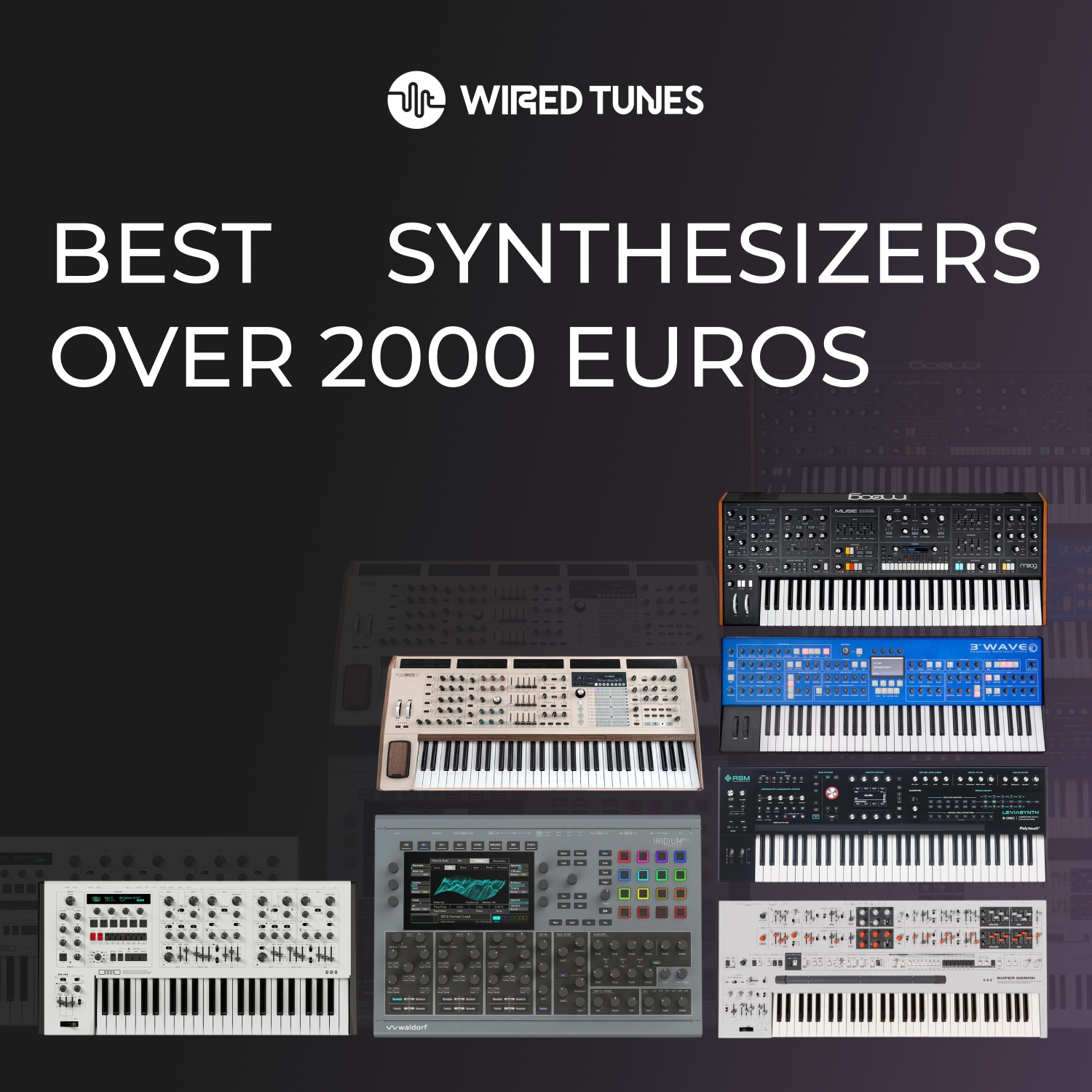
Best Synthesizers Between 1000 and 2000 Euro
The 1000 to 2000 euro range is arguably the most interesting segment of the synthesizer market. There are no more entry-level compromises here, yet the price has not entered collector territory. In this range you will find both proven analogs with years of history and advanced hybrid instruments shaping the modern sound. Below - an honest look at each of them, no embellishment.
Table of contents
1. Expressive E Osmose

Expressive E Osmose arrived on the market after years of anticipation and turned out to be exactly what it promised - an instrument that redefines the very idea of a keyboard synthesizer. A joint project between French company Expressive E and American Haken Audio: on the outside a familiar 49-key keyboard, on the inside the EaganMatrix engine, previously only available in the elite Haken Continuum.
The central idea of Osmose is how it senses your playing. Each key responds to pressure, lateral movement and depth of press independently for every note. This is MPE in a familiar keyboard format, and that is precisely what makes Osmose unique - you do not need to relearn like on a Roli Seaboard. Over 500 factory patches cover physical modeling, FM, virtual analog and granular synthesis.
It is worth being honest: programming your own sounds requires working through a computer. EaganMatrix is a powerful but non-standard environment. Osmose fully reveals itself to those who want to play and explore, not to those who prefer to dial up a patch from scratch. But if you accept this instrument on its own terms - it can completely change your relationship with playing keys.
2. Moog Subsequent 37

Moog Subsequent 37 is an evolution of the legendary Sub 37, and everything people love about Moog is recognizable here: deep, warm, rich sound with the characteristic ladder filter. Mono and paraphonic modes, 37 keys with aftertouch, a redesigned Multidrive circuit for more aggressive saturation, and CV outputs for integration with modular systems.
This is an instrument with a very strong identity. Basses, leads, slowly opening filters - the Subsequent 37 performs flawlessly here. That is exactly the sound people buy it for. What should be understood, though, is that this is not a polyphonic synthesizer, and all the luxury of Moog here is concentrated in a maximum of two voices. Some users have also noted inconsistent build quality across different production runs - Moog did make structural changes, but it is worth keeping in mind when purchasing.
For those who already own a Sub 37, the upgrade is arguably not worth it. But for those entering the Moog world for the first time or looking for a monophonic analog with deep modulation and CV integration - Subsequent 37 remains one of the most convincing choices in its class.
3. Waldorf Iridium Core

Waldorf Iridium Core is the most compact member of the Waldorf flagship lineup. The same engine as in the larger Iridium and Quantum models: five synthesis engines, three oscillators per voice, 12-voice polyphony, two independent layers. Over 1700 factory presets, firmware shared across the entire family - updates arrive for all models simultaneously.
Waldorf preserved what matters most - the engine itself - and reduced the physical controls. If the original Iridium Desktop with its abundance of encoders gives a sense of direct hands-on programming, Iridium Core places its bet on the screen. This is not a downside, simply a different approach. For those who prefer a screen-led interface or work primarily in the studio, the difference is barely noticeable. One point of debate is the decision to use MIDI via TRS mini-jack rather than classic DIN 5-pin connectors - at around 1900 euros, this feels like an unnecessary compromise.
Iridium Core fits perfectly into a studio alongside analog synthesizers - it does what analog cannot, and does it very well.
4. ASM Hydrasynth Deluxe

ASM Hydrasynth Deluxe is the flagship of the ASM lineup, and in terms of feature-to-price ratio it is one of the most well-argued choices in this range. A 73-key keyboard with polyphonic aftertouch, two independent 8-voice engines, a ribbon controller, CV/Gate outputs. Wave-morphing synthesis with a rich modulation matrix - this is genuinely a lot for the money.
The Hydrasynth interface is well thought through: the module buttons let you assign modulation with literally two presses, and the overall control logic becomes intuitive after a few hours of work. The synthesizer is however digital and that is audible - especially in the high frequencies, where a characteristic brightness appears. This is neither good nor bad, but worth knowing what to expect. Pads, evolving textures, experimental sounds - this is where Hydrasynth Deluxe is truly in its element. Polyphonic aftertouch adds a level of expressiveness that is rarely found at this price point.
5. Groove Synthesis 3rd Wave 8M Desktop

Groove Synthesis 3rd Wave 8M Desktop is the most accessible version of the synthesizer from Groove Synthesis, a company founded by Bob Coover with DSP development experience at Sequential. This is the spiritual successor to the PPG Wave, one of the most influential instruments of the 1980s. Wavetable synthesis with analog filters, three oscillators per voice, original 8-bit PPG wavetables alongside modern 96 kHz tables, and a built-in Wave Maker for creating your own wavetables from audio files.
The reduction in polyphony to 8 voices and fewer physical controls compared to the full-size 3rd Wave versions are real compromises worth weighing. But the sound engine, filter quality and complete synthesis toolkit are fully preserved. For those who want a taste of the PPG Wave sound and modern wavetable synthesis without spending 3500 euros or more on the flagship version - this is a compelling entry point.
*Wired Tunes pick
GS Music e7 Blue occupies a special place among analog synthesizers in this price range. It is the first polyphonic analog synthesizer designed and manufactured in Argentina - and by boutique analog standards, a very convincing result. Seven voices, a fully analog signal path, four-part multitimbrality, MPE support and CV inputs. The classic look with wooden side panels and large knobs is paired with an OLED screen that also functions as an oscilloscope.
The sound of the e7 is described as boutique analog with its own character - not a copy of well-known synthesizers, but a voice of its own. This is a synthesizer for those who appreciate classic subtractive synthesis in a modern form with MPE and multitimbrality.
Summary
All five instruments on this list fall within the same price range but serve entirely different purposes. Expressive E Osmose is the only choice for keyboardists who want MPE in a familiar format and are ready to explore new dimensions of expression. Moog Subsequent 37 remains the king of the analog monosynth with classic Moog sound and deep CV integration. Waldorf Iridium Core brings the full spectrum of digital synthesis in a compact enclosure and is a perfect complement to an analog studio. ASM Hydrasynth Deluxe wins on depth of sound design, polyphony and expressiveness at a very competitive price. Groove Synthesis 3rd Wave 8M Desktop stands apart as the wavetable specialist - a direct line to the PPG Wave legacy in a modern, affordable format. The choice does not depend on budget - it depends on the music you want to make.