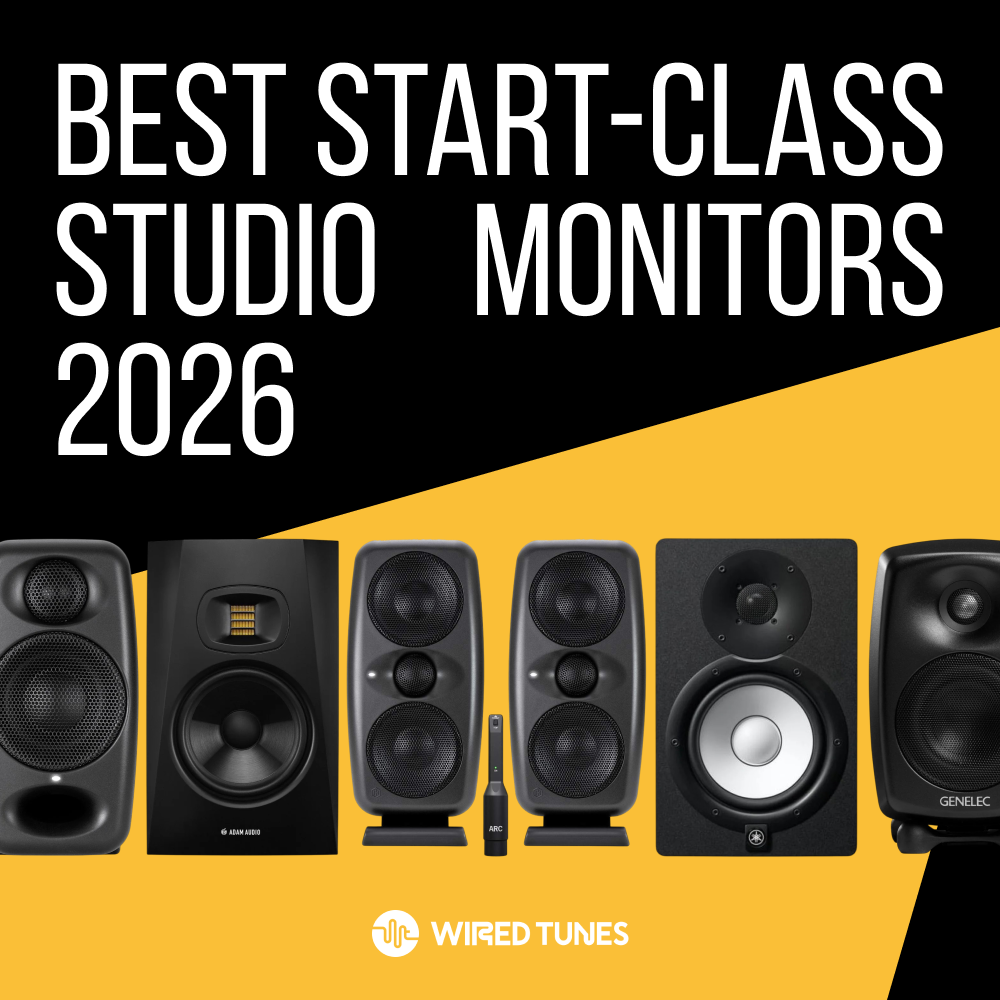


Best Middle-Class Studio Monitors 2026
These five monitors represent the modern forefront of the middle-class segment in 2026 - systems that clearly step above the budget tier, while remaining a realistic choice for well-treated home studios, small commercial rooms, and hybrid production setups. These are monitors that prioritize transparency, frequency control, and predictable translation over an impressive sound at first listen. To be clear: this is not yet the uncompromised high-end segment, but it is exactly in this price and quality range where many conscious producers make the biggest leap forward in their workflow.
Table of Contents
1. PMC result6

PMC result6 is a two-way, active nearfield monitor that serves as the most straightforward entry into the company's ATL technology. Based on a 6.5-inch woofer, a 27-millimeter soft dome tweeter, and a 100 W plus 65 W bi-amped power section, it offers a frequency response that allows for comfortable work in a typical project room. In practice, this monitor sounds fuller and deeper than its physical dimensions suggest - the bass extends surprisingly low and remains articulate even at moderate listening levels.
The advanced Advanced Transmission Line (ATL) cabinet design, characteristic of this brand, avoids the typical compression known from many bass-reflex ports, making the low end fast without bleeding into the lower midrange. The stereo image is very stable, and the model is widely regarded as a tool that excellently reveals relationships in the lower registers - if a mix sits right on these, it usually translates very well to other systems. On the flip side, there is no DSP, no presets, and no automatic calibration here - it is a straightforward, analog monitor that requires a properly treated room and conscious placement.

2. Barefoot Sound Footprint03

Barefoot Sound Footprint03 is the smallest, three-way model in the Footprint family, designed as a highly compact way to access the Barefoot sound without having to place large towers in the control room. It features a 6.5-inch woofer, a dedicated midrange driver, and a ring radiator tweeter, all powered by Class D amplifiers and controlled by internal DSP that handles the crossover and driver correction. As a result, the Footprint03 offers a wide bandwidth with extended lows and very low distortion in the critical midrange.
Sonically, the Footprint03 is quite distinctive: the low end is noticeably extended, but the designers intentionally avoided exaggerated bass-reflex tuning, so the bass remains highly usable in a mix, although a subtle port character can be heard at certain volumes. The midrange is highly readable, providing plenty of texture information, and the tweeter adds a lot of detail without being overly aggressive. However, it is worth noting that this monitor does not offer extensive room correction or app control, meaning the bulk of the optimization still relies on the room's acoustics.

3. PSI Audio A17-M

PSI Audio A17-M is a compact, fully analog reference nearfield monitor, handmade in Switzerland. It is equipped with a nearly 7-inch woofer, a 1-inch tweeter, Class A/B amplifiers, and proprietary phase and response correction circuits (AOI and CPR). This monitor aims for maximum neutrality and consistency without any DSP involvement. In practice, the A17-M can play louder and with more headroom than its size implies, while maintaining excellent control in the low frequencies.
When it comes to listening, the A17-M is considered exceptionally neutral, with very low distortion and a flat response - no artificial presence boost or hyped bass. The stereo imaging is rock-solid, and the sweet-spot is relatively wide, which makes daily work much easier. The low end reaches objectively deep for a monitor of this volume, but if you work heavily with bass-centric electronic music, adding a subwoofer or double-checking the lowest sub-frequencies on reference headphones might be a sensible idea.

4. Genelec 8030C

Genelec 8030C is one of the most classic, compact monitors found in studios around the world - combining a small footprint with solid power and highly refined ergonomics. Based on a 5-inch woofer and a small metal dome tweeter, powered by dual 50 W amplifiers, it delivers an extended low-frequency response thanks to an optimized bass-reflex port. This monitor is clearly designed with smaller rooms and typical production desks in mind.
The aluminum MDE enclosure and the DCW waveguide play a crucial role here, working together to provide a very smooth frequency response and a wide sweet-spot. The sound of the Genelec 8030C is clear and direct, with a great midrange presentation and surprisingly low bass distortion at moderate listening levels. The main limitation is, of course, physics: a 5-inch driver cannot replace larger midfields in a big control room, and it might lack headroom in the sub-bass during louder sessions.

5. Neumann KH 310

Neumann KH 310 is a three-way, active monitor that very often serves as the first serious main monitoring system in small to medium-sized studios. Featuring an 8.25-inch woofer, a dedicated midrange driver, and a tweeter with separate power amplifiers, it offers a frequency range extending down to around 34 Hz and can generate significant acoustic pressure while keeping the signal pristine. Because of this, the Neumann KH 310 can successfully act as the sole, full-range monitor in a control room.
It utilizes the MMD waveguide, which ensures even dispersion, allowing for a stable stereo image even when you slightly shift your position behind the console. Sonically, this design is incredibly neutral and dry, with perfectly controlled bass and a highly detailed midrange. It is a tool that instantly exposes flaws in a mix. However, keep in mind that the KH 310 is a fairly large monitor - in the smallest, poorly treated rooms, it might generate too much low-end energy, making a smaller two-way design a more reasonable choice.

Summary
The middle-class tier is where serious, critical audio work begins. PMC result6 and Barefoot Sound Footprint03 show two different approaches to active nearfield monitoring - from a raw, analog signal path with an advanced cabinet, to a modern, DSP-driven three-way design. PSI Audio A17-M and Genelec 8030C, on the other hand, are excellent compact tools for smaller spaces; the former focuses on almost clinical neutrality, while the latter delivers high ergonomics and a wide sweet-spot.
Neumann KH 310 acts as a natural bridge between the middle class and the high-end in this lineup, offering a three-way, full-range reference. Choosing a specific model depends mostly on the size of your room and your personal sonic preferences. If you are stepping up to this level from budget monitors, a properly positioned pair from these five will most likely completely transform your workflow and the way you control your mixes.