

IGS Audio
IGS Audio Tilt n Bands
This item is available on a custom order basis only. Please contact us for more details. Kontaktieren Sie uns
Optionen wählen
This item is available on a custom order basis only. Please contact us for more details. Kontaktieren Sie uns
This item is available on a custom order basis only. Please contact us for more details. Kontaktieren Sie uns
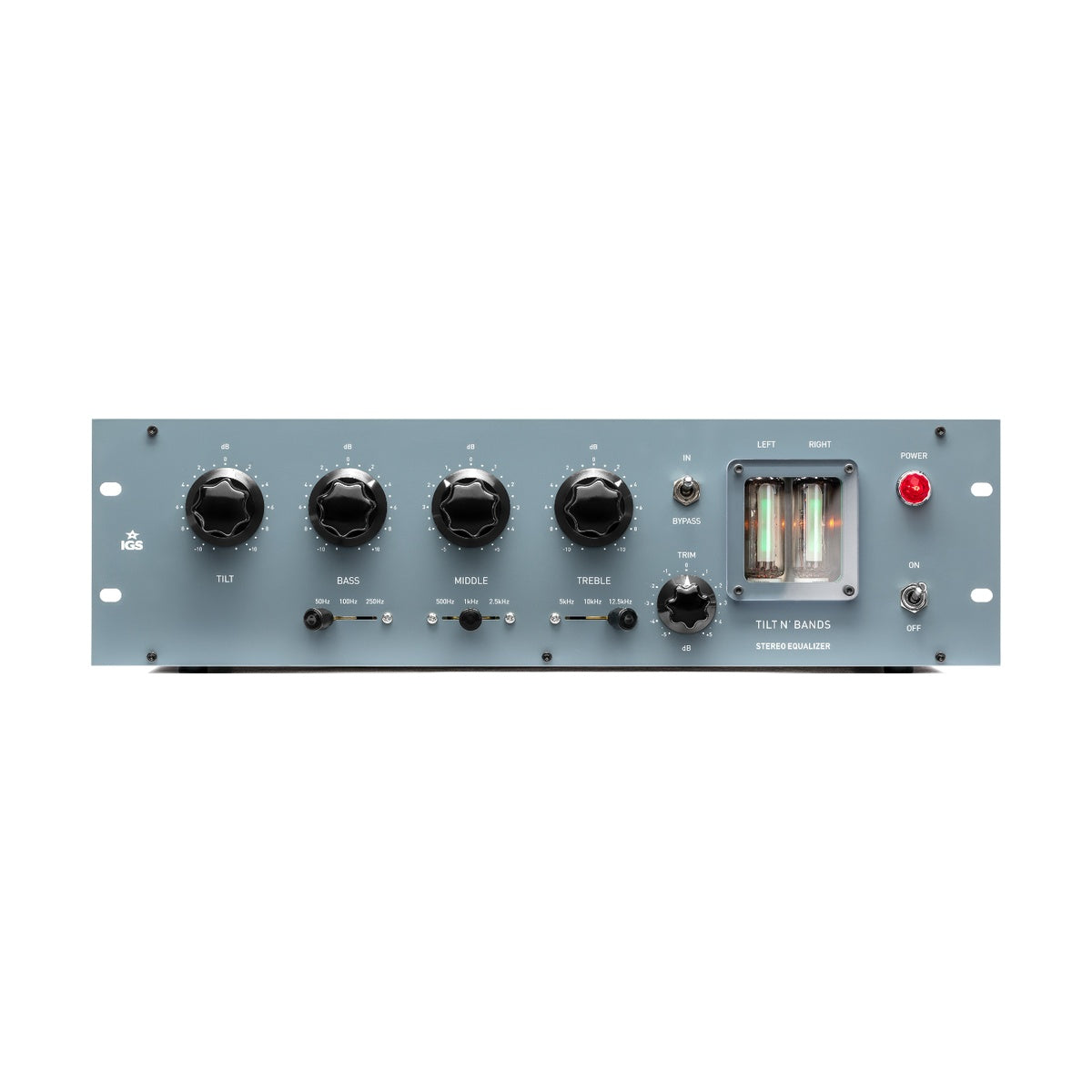
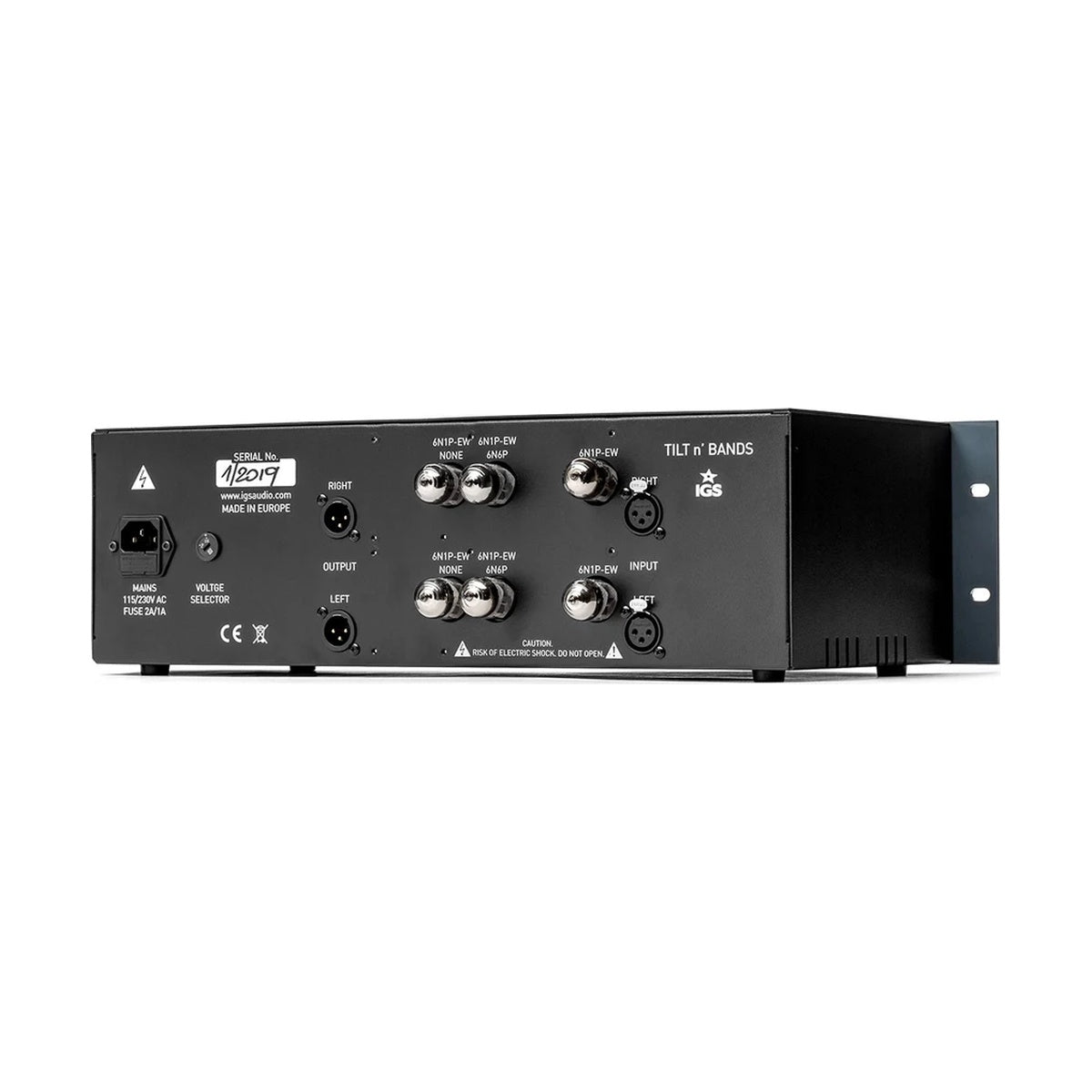
Tilt n Bands is a tube stereo mastering equalizer with an internal linear power supply, designed by Igor Sobczyk of IGS Audio based on a vintage hi-fi circuit with a transformer-balanced tube output stage. The signal path runs through IGS Custom transformers on input and output and six 6N1P triode valves; level metering uses 6E2 magic eye tubes – vacuum indicator tubes from 1950s and 1960s hi-fi amplifiers. Three bands (bass, mid, treble) with selectable frequencies and Q adjustable from 0.5 to 5 are joined by a TILT control – a linear tilt of the entire frequency response curve up to a maximum slope of 1 dB/oct. Hard-wire bypass. Internal linear power supply 115/230 V. Power consumption: 64 W. Shipping weight: 11 kg.
The TILT control – how it differs from shelving
A conventional shelving filter boosts or cuts one end of the frequency range at a fixed corner frequency, leaving the other end flat. A tilt filter rotates the entire frequency response around a centre pivot point – simultaneously boosting the low end while cutting the high end (or vice versa), producing a curve that is close to a straight line. In the Tilt n Bands, the TILT control generates a nearly ruler-straight slope to a maximum of 1 dB/oct, meaning at full deflection the difference between 20 Hz and 20 kHz is approximately 10 dB. This is a global tonal balance tool for mixes and masters: if a mix sits too bright, one TILT adjustment rebalances it without touching individual band relationships. The straight slope avoids the resonances and phase distortions that shelving filters introduce at extreme settings.
Three switchable bands through a tube circuit
The bass band offers 50, 100, or 250 Hz; mid offers 500 Hz, 1 kHz, or 2.5 kHz; treble offers 5, 10, or 12.5 kHz. Each band is controlled by a ±10 dB knob with a centre detent at 0 dB. A TRIM control handles overall output level adjustment. The 6N1P tube circuit in a transformer-balanced configuration adds the colouration and saturation character of vintage hi-fi design – the unit is aimed primarily at mastering and mix bus work, where a few decibels of correction at selected frequencies is sufficient to reshape the entire tonal balance. Frequency response: 20 Hz – 40 kHz ±0.3 dB. THD+N: 0.08% at 1 kHz and +4 dBu. Crosstalk: above 120 dB.
KEY FEATURES
- Tube stereo mastering equalizer with TILT filter and three selectable bands
- TILT filter: linear slope up to 1 dB/oct across the full frequency range
- BASS band: 50 / 100 / 250 Hz (±10 dB)
- MID band: 500 Hz / 1 kHz / 2.5 kHz (±10 dB)
- HIGH band: 5 / 10 / 12.5 kHz (±10 dB)
- Q: 0.5–5
- IGS Custom transformers on input and output
- Tubes: 6× 6N1P + 2× 6E2 (magic eye level indicators)
- Hard-wire bypass
- TRIM control for output level
- Internal linear power supply 115/230 V
TECHNICAL SPECIFICATIONS
- Type: tube stereo equalizer with tilt filter, rackmount
- Tubes: 6× 6N1P + 2× 6E2 (magic eye)
- Transformers: IGS Custom (input and output)
- BASS band: 50 / 100 / 250 Hz
- MID band: 500 Hz / 1 kHz / 2.5 kHz
- HIGH band: 5 / 10 / 12.5 kHz
- Q: 0.5–5
- Band correction range: ±10 dB
- TILT filter: up to 1 dB/oct linear slope
- Input impedance: 10 kΩ (balanced)
- Output impedance: 600 Ω (balanced)
- Operating level: +4 dBu
- Maximum output level: +19 dBu
- Frequency response: 20 Hz – 40 kHz ±0.3 dB
- THD+N: 0.08% (1 kHz, +4 dBu)
- Crosstalk: above 120 dB
- Metering: 6E2 magic eye tubes
- Bypass: hard-wire
- Power supply: 115/230 V, 50/60 Hz, linear, internal
- Power consumption: 64 W
- Shipping weight: 11 kg