

IGS Audio
IGS Audio SPRINGTIME
This item is available on a custom order basis only. Please contact us for more details. Contact us
Choose options
This item is available on a custom order basis only. Please contact us for more details. Contact us
This item is available on a custom order basis only. Please contact us for more details. Contact us
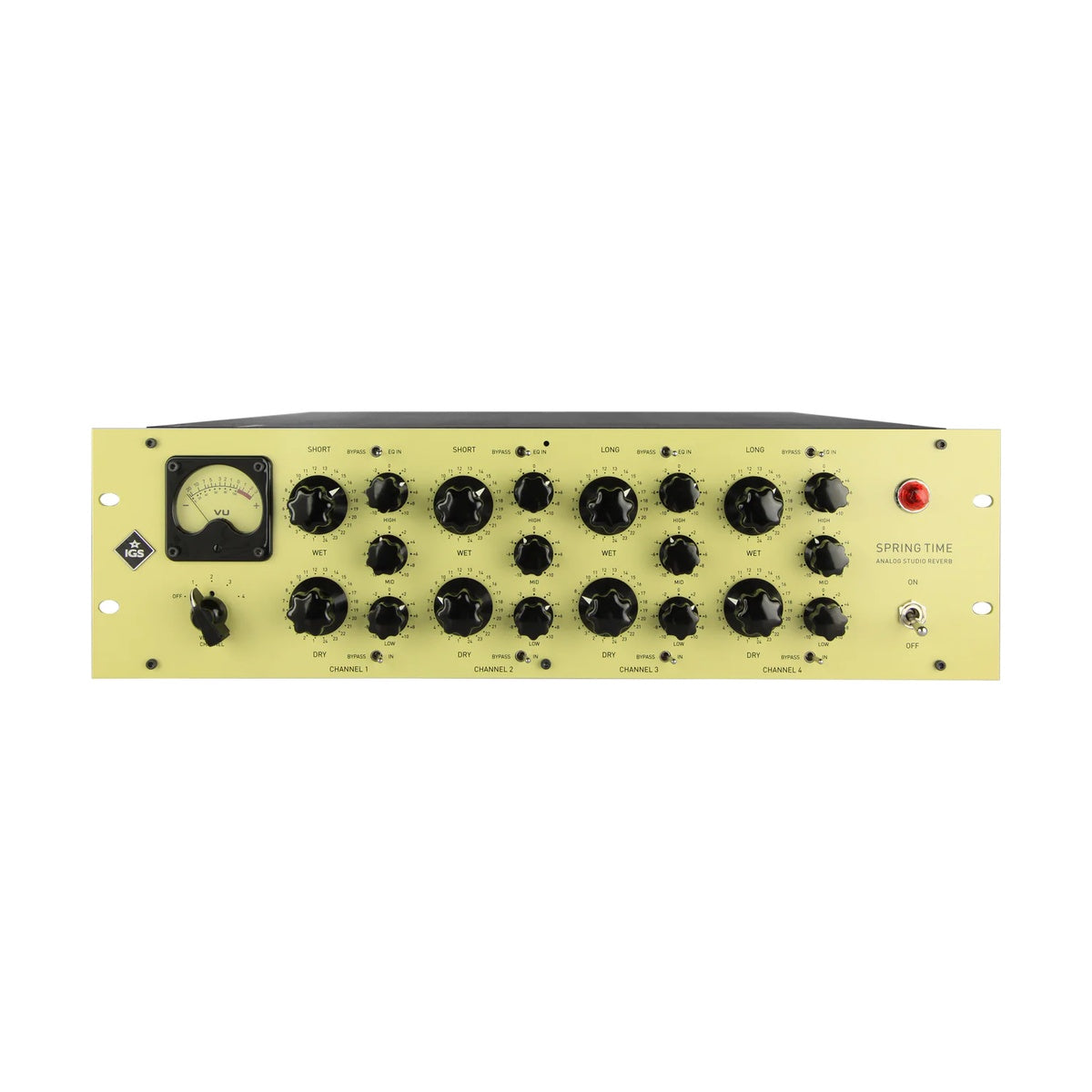
IGS Audio Springtime is a four-channel analog spring reverb in a large chassis housing four full-size spring tanks — two pairs of short springs (channels 1–2) and two pairs of long springs (channels 3–4). Each channel is mono and fully independent: separate Wet and Dry controls on 24-position Elma switches, a three-band Baxandall equalizer on the wet signal path, and a hardwire bypass per channel. Input impedance of 10 kΩ, output impedance of 50 Ω, THD+N of 0.001% at 1 kHz, and 120 dB dynamic range place the Springtime firmly in professional studio territory rather than the novelty end of spring reverb.
Short and Long Springs — Two Reverb Characters in One Unit
The short springs (channels 1–2) produce dense, tight reverb with clear attack definition — suited for solo vocals, acoustic instruments, and individual tracks where decay time needs to stay controlled and the midrange must remain articulate. The long springs (channels 3–4) deliver an open, expansive space with the characteristic upper-frequency shimmer and organic low-end weight of a long spring tank. Used as a stereo send on the mix bus (L to channel 3, R to channel 4) the Springtime adds cohesion and depth in a way that digital spring emulations — however accurate — cannot physically replicate: the actual mass and inertia of a spring element responds to transients differently from any algorithm. Individual instruments can be sent to both spring types simultaneously in a parallel configuration for a richer, layered ambience.
Per-Channel Baxandall EQ and Console Routing
The three-band Baxandall EQ in the wet signal path operates independently from the dry path — reverb character is shaped without touching the direct signal. The ±15 dB range per band covers both subtle tank character adjustment and aggressive shaping: a HF boost of +12 dB produces bright, crackling guitar-amp reverb; cutting the mid pushes the reverb deeper into the mix without reducing its level. The EQ bypass per channel allows instant A/B comparison of the spring's natural character against the corrected version. Insert use: 100% Dry, 10–30% Wet. Aux send use: 100% Wet, 0% Dry. The VU meter monitors the reverb output level.
KEY FEATURES
- 4-channel fully analog spring reverb — 4 independent full-size spring tanks
- Channels 1–2: short springs (dense, tight reverb — vocals, solo instruments)
- Channels 3–4: long springs (open, expansive space — stereo send, mix bus, ensemble)
- 3-band Baxandall EQ per channel on wet signal path, ±15 dB
- Separate Wet and Dry controls per channel — 24-position Elma switches
- Hardwire bypass per channel + EQ bypass per channel
- Input impedance: 10 kΩ (balanced XLR)
- Output impedance: 50 Ω (balanced XLR)
- Operating level: +22 dBu
- Headroom (at +4 dBu): 18 dB
- Dynamic range: 120 dB
- THD+N: 0.001% at 1 kHz, +4 dBu
- VU meter: reverb output level
- Power: 90–240 V AC, 10 W
- Shipping weight: 10 kg; packaging dimensions: 480 × 480 × 133 mm
- Made in: Poland
TECHNICAL SPECIFICATIONS
- Type: four-channel analog spring reverb
- Channels: 4 mono (2 × short springs + 2 × long springs)
- Input impedance: 10 kΩ (balanced)
- Output impedance: 50 Ω (balanced)
- Operating level: +22 dBu
- Headroom (at +4 dBu): 18 dB
- Dynamic range: 120 dB
- THD+N: 0.001% at 1 kHz, +4 dBu
- Frequency response: 20 Hz – 20 kHz, ±0.1 dB
- EQ: 3-band Baxandall per channel, ±15 dB
- Wet/Dry: 24-position Elma switches
- Bypass: hardwire, per channel
- Metering: VU reverb output level
- Power: 90–240 V AC, 10 W
- Packaging dimensions: 480 × 480 × 133 mm
- Shipping weight: 10 kg
- Made in: Poland