

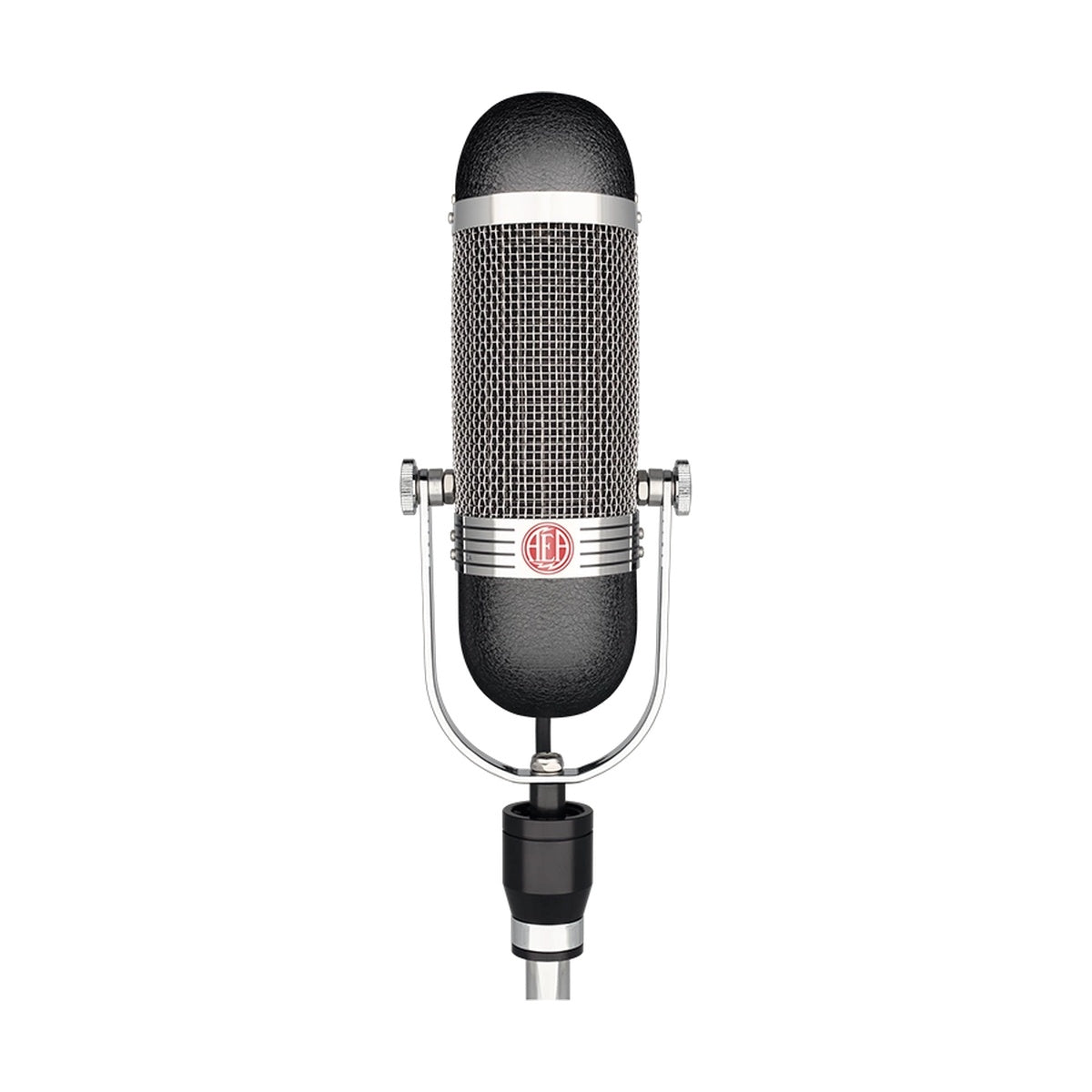
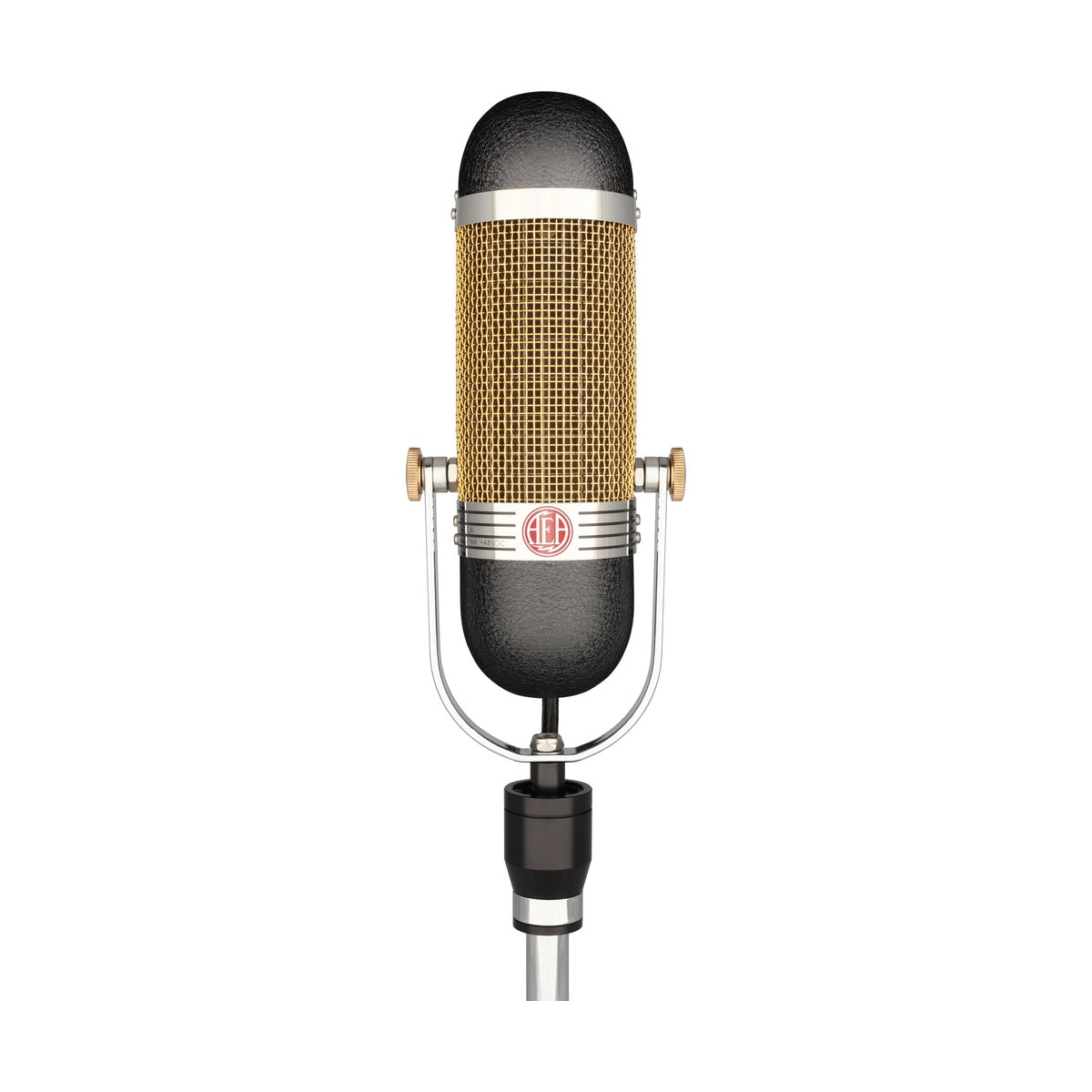
AEA R84 is a passive ribbon microphone in the Big Ribbon format, introduced in 2000 as a more compact and accessible version of the R44C. The 1.8-micron aluminum ribbon at 59.7 mm × 4.7 mm, the transformer, and the 16.5 Hz resonant tuning are identical to the R44C; the motor uses modern design techniques with stronger but smaller permanent magnets. The result is classic RCA 44 tonality with extended top-end response, reduced proximity effect, and better mechanical vibration isolation in a body weighing 1.36 kg instead of the R44C's 3.6 kg.
Big Ribbon and 16.5 Hz Tuning — Dynamics and Low End Without Resonance
Ribbon resonant tuning below the audible band (16.5 Hz) means the R84 exhibits no mechanical resonances in the 20 Hz–20 kHz range — a common problem with shorter ribbon elements and condenser capsules that show audible response peaks. In practice this translates to smooth, coherent low-frequency reproduction of drums and bass instruments, accurate transient attack without exaggeration, and a high-frequency rolloff that avoids the harshness of condenser designs. Proximity effect is present but less pronounced than in the R44C — at 12–24 inches the R84 holds a tonal balance comparable to what the R44C delivers at roughly 3 feet. This makes it practical for close-miking (amplifiers, brass, percussion) as well as medium-distance applications (vocals, acoustic instruments, strings). Maximum SPL of 165+ dB handles speaker-level signals from cranked amplifiers without any external attenuator.
Passive Signal Path and Preamp Requirements
The R84 requires no phantom power and is not recommended with it — 48 V can damage the ribbon if the cable or preamp circuit is unbalanced or develops a fault. Sensitivity of 2.5 mV/Pa (–52 dBV) is higher than the R44C (1.8 mV/Pa) and substantially higher than the Coles 4038 (0.5 mV/Pa), but still demands a preamp with at least 60 dB of gain and a load impedance above 1.2 kΩ for full frequency response. For loud sources, any console preamp presenting above 5 kΩ is adequate; for quiet sources or distance recording, AEA's dedicated ribbon preamps are recommended. The microphone ships with a 3-meter captive cable terminating in XLR-3M, a shockmount, and a foam-lined carrying case.
KEY FEATURES
- Passive Big Ribbon — same ribbon element, tuning (16.5 Hz), and transformer as the R44C
- Modern motor with stronger magnets — extended HF and reduced proximity effect vs. R44C
- Polar pattern: figure-8 (bidirectional)
- Max SPL: 165+ dB (1% THD harmonic distortion >1 kHz)
- Sensitivity: 2.5 mV/Pa (–52 dBV) into unloaded circuit
- Output impedance: 270 Ω nominal
- Recommended load impedance: ≥1.2 kΩ
- Phantom power: not required or recommended
- Smooth top-end response — extended and controlled vs. R44C, no condenser harshness
- Off-axis rejection: –35 dB at 90°/270° (both axes)
- 3 m captive cable, XLR-3M connector
- Accessories: shockmount, 3 m cable, foam-lined carrying case
- Dimensions: 295 mm (H) × 99 mm (W) × 64 mm (D); weight: 1.36 kg with cable
- Handmade in Pasadena, California, USA
TECHNICAL SPECIFICATIONS
- Operating principle: pressure gradient transducer (passive)
- Polar pattern: figure-8 (bidirectional)
- Frequency range: <20 Hz – >20 kHz
- Max SPL: 165+ dB (1% THD >1 kHz)
- Sensitivity: 2.5 mV/Pa (–52 dBV) into unloaded circuit
- Output impedance: 270 Ω nominal
- Recommended load impedance: ≥1.2 kΩ
- Phantom power: not required or recommended
- Polarity: Pin 2 + for positive pressure at front
- Off-axis rejection: –35 dB at 90°/270° (horizontal and vertical)
- Ribbon thickness: 1.8 µm; width: 4.7 mm; length: 59.7 mm
- Ribbon material: corrugated aluminum
- Resonant tuning: 16.5 Hz
- Connector: XLR-3M on 3 m captive cable
- Dimensions: 295 mm (H) × 99 mm (W) × 64 mm (D)
- Weight: 1.36 kg (with cable); 1.8 kg (with case)
- Made in: USA (Pasadena, CA)