


Active Studio Monitors, How to Choose the Right Pair
Active studio monitors are speakers with the amplifier already built in, tuned by the maker to match the exact drivers inside, so you plug them straight into your interface and start mixing. That built-in amp is the whole pitch, and it is why active monitors have quietly won the home studio. (My partner calls them the black boxes. I call them the most honest speakers in the flat. We are both right.) If you remember one line, active means plug and play, passive means you still have shopping to do.
The short version. An active studio monitor has its amplifier inside the cabinet, matched to the drivers, so it needs only power and a signal cable to run. That makes it simpler, more consistent, and the right call for almost every home and project studio. A solid nearfield pair like the ADAM T7V gets most rooms going for around 866 zł a speaker, and the ladder runs all the way up to reference pairs from PMC, Genelec, PSI Audio and Kii Audio. Best move of all, come hear a few side by side at our Warsaw showroom before you spend a złoty.
What an active studio monitor actually is
The amp placement is the whole story. On an active monitor the power amplifier lives inside the cabinet, wired straight to the drivers and tuned by the manufacturer for that exact speaker. On a passive monitor there is no amp inside, so you supply your own external one and hope you matched it well. Active takes the guesswork out. The maker already did the pairing, and they did it better than a spec sheet and a hopeful afternoon ever could.
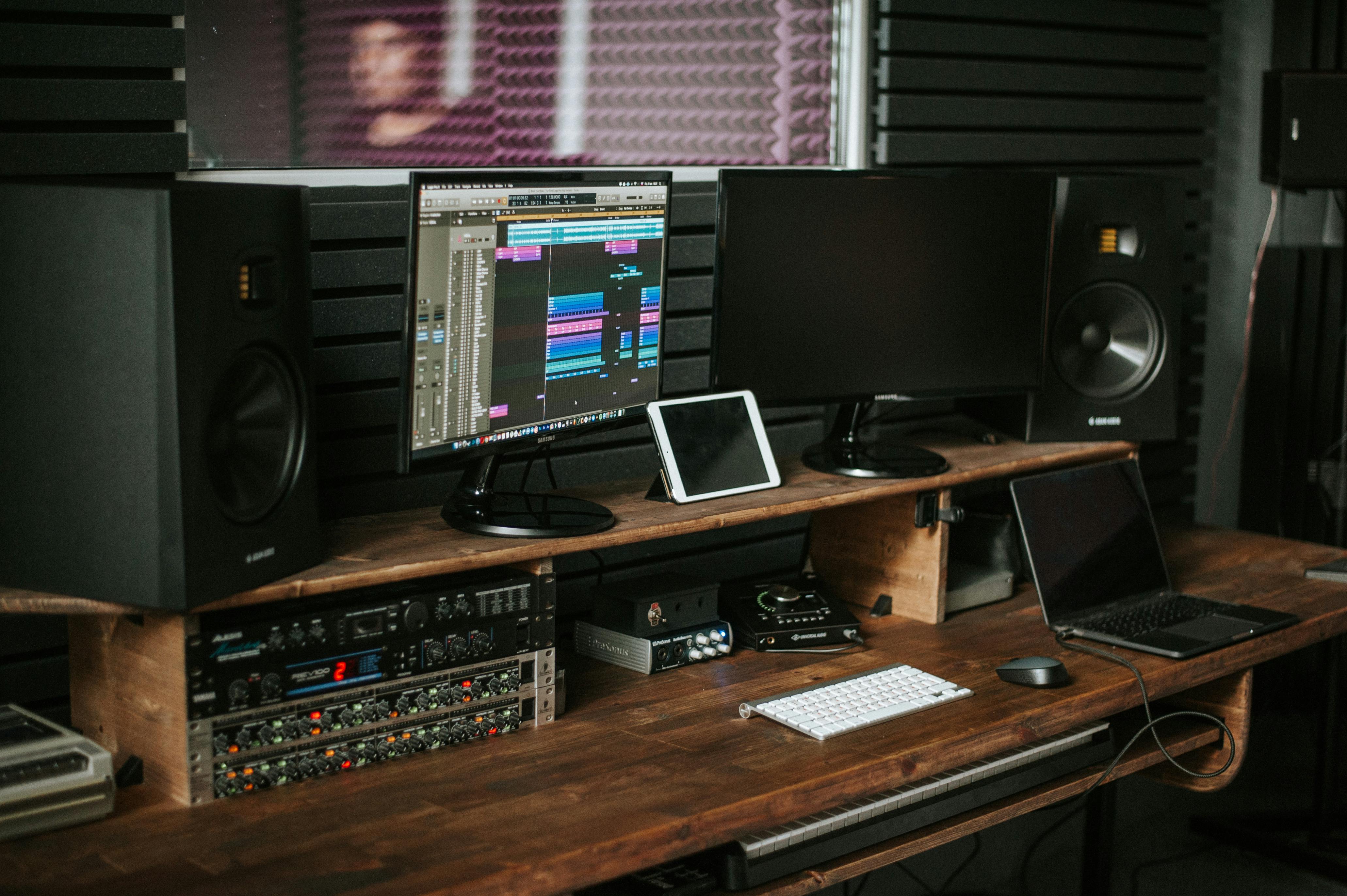
The other half of the story is what these speakers are for. A studio monitor is built to be honest, not flattering. A hi-fi speaker massages the sound to please you, lifting the bass and sweetening the top so your playlist feels great. A monitor stays flat and neutral so you hear the mix as it really is, dry, exposed, flaws and all. That difference is exactly why studio monitors versus normal speakers is not a fair fight for mixing. You want the speaker that tells you the truth, then you go enjoy music on the one that lies nicely.
Active or passive, and why the question is basically settled for home
For a home or project studio, active wins almost every time. The amp is matched to the drivers, so you buy one box instead of two and you cannot mismatch them. There is less to go wrong, less to carry, and less to shop for. Passive monitors still have their place, mainly in bigger rooms or when someone already owns an amp they trust and have a real reason to keep. For the other ninety percent of us, active monitors are the sensible default and have been for years.
Most active nearfields also give you tone controls on the back, a shelf or two to tame a bright room or a wall that is too close. The pricier ones add proper DSP room correction, and the cleverest, like Genelec's auto-calibration or Kii's cardioid bass, go further still. It helps. It does not cure. I will come back to that, because it is the part people spend the most money getting wrong.
What size, the inches question
The number everyone fixates on is the woofer size, quoted in inches, and it maps roughly to room size and low end. Nine times out of ten, a 5-inch nearfield is the right call for a bedroom or a small room. A 7 or 8-inch pair reaches lower and fills a bigger space, but in a tiny room a big woofer just pressurises the walls and hands you a boomy, unreliable bottom end. Bigger is not better here. Bigger is a bigger argument with your room.
So the honest way to pick which studio monitors to choose is to start from your room, not from the biggest speaker your budget allows. Measure the distance from where your head sits to where the speakers will go. If that is under about two metres, which describes most home desks, a 5 or 7-inch nearfield is plenty. Save the big three-way dream for the day you have the room to feed it. (I own a pair I cannot properly use in my flat. That is not advice. That is GAS with a receipt.)
Where you put them matters more than which you buy
You can spend a fortune on monitors and still get a bad answer if you set them up wrong. Here is the how to set up studio monitors short course. Put the two speakers and your head at the three points of an equal triangle, tweeters at ear height, angled in toward you. Keep them off the desk surface if you can, on stands or isolation pads, because a bare desk turns into a resonating soundboard and smears your low mids. Pull them a little off the wall behind them, since a monitor jammed against a wall gains a boomy bass that is not really in the mix. Ten minutes of this beats a hundred złoty of upgrade.

And symmetry matters as much as the triangle. If one speaker sits in a corner and the other floats in open space, your stereo image is lying to you before you have touched a fader. Same distance to the side walls, same height, same angle. Your ears are more sensitive to that mismatch than any brochure will admit.
The one upgrade that beats new monitors
Here is my one hill to die on. Room treatment beats a monitor upgrade almost every time, and it is not close. I had a customer with 8,000 zł monitors in a bare, square Warsaw flat who still could not trust his low end. Every mix came back boomy in the car. We spent 300 zł, call it seventy euros, on corner bass traps. That did more for his mixes than the expensive speakers ever had. A monitor is only ever as honest as the room around it. A great pair in an untreated room is a race car in a car park, all that capability and nowhere to use it.
This is why I will happily talk you out of the fancier pair. If your room is bare, buy the sensible good studio monitors and put the difference into a few bass traps and some panels at the first reflection points. DSP correction, the clever kind on Genelec's SAM range or the cardioid trick inside a Kii, flattens the response and tames the room, but it still cannot delete a slap-back echo off a bare wall behind your head. Correction compensates for a room. Treatment fixes one. Fix the room first, every time.
How to actually plug them in
Connecting a pair trips up more people than any spec, so let us be plain about it. Each active monitor takes its own signal cable, which means a stereo pair needs two outputs from your audio interface, one for left, one for right. Use balanced cables where you can, TRS jack or XLR, because balanced runs shrug off the hum that unbalanced cables invite in an old building. If you want one knob to ride instead of leaning over to the interface every time, a monitor controller sits between the two and does exactly that. And flip phantom power off before you plug anything in. Twenty years in and the mysterious blue light of shame still catches me when I forget.
The active monitors worth buying, first pair to end game
Skip the best-of listicles written by people who never plugged the things in. In our showroom, the active monitors that earn their keep run in a clean ladder from a first honest pair to the ones you stop upgrading at. Prices are today's shelf, and shelf prices move.
- The honest first pair. The ADAM T7V is a 7-inch nearfield around 866 zł a speaker, with a ribbon-style tweeter that stays clean where cheap domes turn harsh. The right place to start a small room.
- Stepping into reference. The PMC Result 6 brings PMC's ATL bass loading down to a nearfield at 10.990 zł the pair. Extended, even low end with no DSP tricks, just engineering doing the work.
- Swiss, hand-built, fully analog. The PSI Audio A17-M around 8.599 zł a speaker is tuned by hand in an anechoic chamber and ships with its own measurement sheet. Not a scrap of DSP anywhere in the path.
- Coaxial that calibrates itself. The Genelec 8331A from The Ones series, around 8.690 zł a speaker, is a three-way coaxial that measures your room and corrects itself through GLM. Point-source imaging out of a tiny cabinet.
- The active cardioid flagship. The Kii SEVEN system, around 38.500 zł with its controller, aims the bass forward and refuses to let the room join in. The pair you stop upgrading at, if GAS ever lets you stop.
Whatever you land on, you get 36-month warranty across the range, and a full 60 months on ADAM Audio and PMC. Free shipping on orders over 900 zł, a 30-day return window if the pair is not for you, and a 30-day Test-Drive on eligible gear, so you can hear a serious pair like the PMC or the PSI in your own room for a month before you commit. But honestly, do not buy monitors from a description. Your room has an opinion, and it always wins the argument.
Straight answers
Active or passive studio monitors, which is better?
For a home or project studio, active. The amplifier is built in and matched to the drivers, so you buy one box, cannot mismatch it, and have less to go wrong. Passive makes sense mainly in bigger rooms or when you already own an amp you trust.
What size studio monitors do I need for a home room?
A 5-inch nearfield suits most bedrooms and small rooms. Step up to 7 or 8-inch only if the room is genuinely bigger and needs more low end. In a small room a large woofer just overloads the walls and makes the bass unreliable.
How do I connect active studio monitors?
Run one balanced cable, TRS or XLR, from each output of your audio interface to each monitor, one left and one right. That is it. Add a monitor controller between them if you want a single volume knob instead of reaching for the interface.
What is the difference between studio monitors and normal speakers?
Hi-fi speakers flatter the sound to please you, lifting bass and sweetening treble. Studio monitors stay flat and neutral so you hear every flaw. You mix on the honest one, then enjoy music on the flattering one.
Do active studio monitors have to be expensive?
No. A capable nearfield pair starts well under 900 zł a speaker. Once you have an honest pair, spend the next money on treating the room rather than on a bigger price tag. The room is usually the real bottleneck.
A good pair of active monitors will show you every flaw in your mix, including the ones your room is quietly adding for free. Come plug a few pairs in at the showroom, tell us the size of your room, and we will argue about bass traps until closing. Bring the tracks. We have got the coffee, and the honest opinion.

Kii SEVEN System FineTouch Dark Grey 3-way DSP-Controlled Active Monitor System (Pair)